
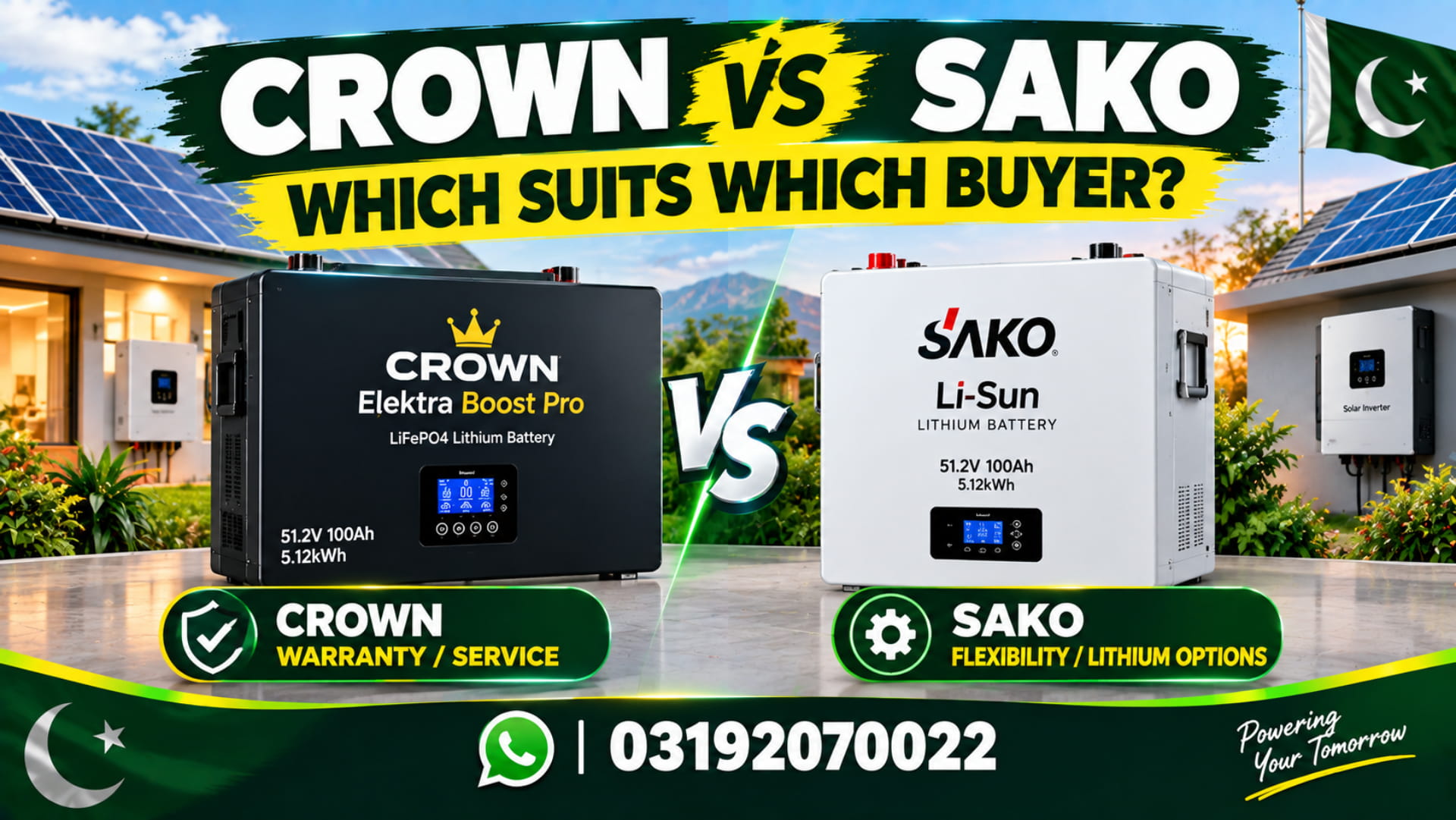
These two brands rarely get compared directly, and that is itself the useful fact. Crown and Inverex, Crown and Knox, those are genuine head-to-head rivalries fought over the same grid-connected household buyer. Crown and Sako are usually solving different problems for different people, which makes “which is better” the wrong question. The right question is which one is built for the situation you actually have.
We stock both brands at Buy Inverter, so here is the honest version of where each one wins and where it does not. For a recommendation matched to your exact situation, WhatsApp 03192070022.
The Short Answer
If your property has a reasonably stable grid connection and you want a hybrid inverter that balances solar, battery and grid power automatically, Crown is almost always the better fit, and usually the cheaper one.
If your property has no reliable grid connection at all, or you specifically need an inverter built to run pumps and heavy motors directly from solar during the day with or without a battery, Sako’s Sunon and Sunon Pro range is purpose-built for exactly that and generally outperforms Crown in that specific scenario.
Neither brand is simply “better” in the abstract. They were designed around different assumptions about what the grid looks like where you live.
What Crown Actually Is
Crown Solar Energy has become one of the highest-volume inverter brands in Pakistan over the last two to three years, built around hybrid units that manage solar, battery and grid power together. The Yorker, Xavier, Elego and Nexus tiers span budget indoor units through fully sealed IP66 outdoor hybrids, with dual MPPT, 18A input current and lithium BMS communication available across most of the mainstream range.
Crown’s core strength is price-to-feature value on hybrid, grid-connected installations. At nearly every capacity we sell, a Crown unit with comparable specification costs 15% to 30% less than the equivalent Inverex, Knox or Sako hybrid model. Our full Crown inverter price in Pakistan guide and our honest is Crown a good inverter brand review both go deeper on where Crown specifically earns and loses its reputation.
What Sako Actually Is
Sako is not trying to be a general-purpose hybrid brand, and comparing it to Crown feature-for-feature on a hybrid spec sheet misses the point of what it was built for. The Sunon and Sunon Pro lines are designed around off-grid and weak-grid operation: heavy MPPT charge controllers, strong surge ratings for starting pumps and motors, and the ability to run loads directly from solar during the day with no battery attached at all, something most hybrid-focused brands, Crown included, do not prioritise in the same way.
The Sunon Pro 5.5kW, for example, carries a 100A MPPT controller and an 11,000VA surge rating on a 5,500VA continuous unit, built specifically to handle the startup demand of agricultural pumps and heavy motors rather than just household AC loads. Our Sako inverter price in Pakistan guide and the dedicated Sako Sunon Pro 5.5kW breakdown cover the full range and specifications.
The Sunpolo line adds grid feed-in capability for buyers who do want some grid interaction, but Sako’s core reputation and strongest engineering sit in the off-grid Sunon range, not in competing with Crown’s hybrid lineup directly.
Head-to-Head Comparison
| Factor | Crown | Sako |
|---|---|---|
| Core design purpose | Hybrid: solar, battery, grid together | Off-grid and weak-grid specialist |
| Typical price at equal capacity | Lowest of the major brands | Comparable to slightly higher for equivalent off-grid capability |
| Best IP rating available | IP66 (Nexus line) | Generally IP21, indoor-focused |
| MPPT and surge strength | Strong dual MPPT, 18A input | Very strong, built for motor and pump starting loads |
| Battery-free daytime operation | Possible on some models, not the design focus | A genuine core strength |
| Grid interaction and net metering | Full hybrid management, on-grid capable | Limited; Sunpolo adds feed-in, Sunon does not prioritise it |
| Service network breadth | Growing but thinner outside major cities | Thinner still outside major cities and agricultural regions it serves |
| Best for | Grid-connected households wanting hybrid backup | Farms, tube wells, weak-grid areas, battery-free solar pumping |
Neither column is a weakness relative to the other once you match it to the right buyer. Crown’s thinner off-grid motor-starting performance is irrelevant to a household that always has grid access. Sako’s lighter hybrid grid-management feature set is irrelevant to a farm that has no grid to manage.
Where Crown Clearly Wins
Grid-connected households of any size. If WAPDA power is available, even with regular load shedding, Crown’s hybrid architecture is built exactly for that situation: drawing from solar when available, battery when needed, and grid as the fallback, automatically.
Buyers prioritising price. Crown undercuts Sako and nearly every other brand at comparable hybrid specification, which matters most to budget-conscious household buyers rather than specialised agricultural or off-grid buyers.
Outdoor installations needing sealing. The Nexus line’s IP66 rating has no real equivalent in Sako’s current lineup, which runs mostly IP21 and assumes indoor or sheltered mounting.
Net metering ambitions. Crown’s broader on-grid and hybrid range is built around DISCO-approved net metering use cases in a way Sako’s Sunon line, by design, is not.
Where Sako Clearly Wins
Farms and tube wells with no reliable grid. This is Sako’s entire reason for existing. Starting a large agricultural pump motor reliably, day after day, directly from solar, is a demanding job that Sako’s heavy MPPT and high surge rating handle better than most hybrid-first brands, Crown included.
Daytime-only commercial loads with no battery. A workshop, cold store or processing shed that only operates during daylight hours can run directly from solar through a Sako Sunon unit without the added cost of a battery bank at all, a genuine cost saving for the right use case.
Areas with no grid connection at all. Interior Sindh, parts of Balochistan, and remote farm properties where WAPDA simply is not an option. Sako was engineered around this reality in a way most competing brands treat as a secondary use case.
Heavy motor-starting surge demand. Beyond agricultural pumps, any application with a large single motor load, a borewell, an industrial fan, a water lift, benefits from Sako’s surge headroom specifically built for that kind of starting current.
Battery Behaviour Differs Between the Two Approaches
The way each brand’s typical use case interacts with a battery bank is worth understanding before you buy. Crown’s hybrid units, used in a grid-connected home, generally keep the battery topped up from grid or solar and lean on it mainly during outages, so the battery spends much of its life sitting near full charge with periodic, predictable discharge cycles. Sako’s off-grid installations, by contrast, often cycle the battery daily between solar charging and overnight discharge, since there is no grid to fall back on, which is a harder, more frequent cycling pattern that makes battery chemistry and depth-of-discharge rating matter considerably more over the system’s lifetime.
This is not a reason to prefer one brand over the other on its own, but it does mean an off-grid Sako installation deserves more attention to battery cycle life and lithium’s deeper usable discharge than a grid-connected Crown household running mostly on backup power. Battery pricing for either configuration moves too often to print reliably here, so WhatsApp us now for the latest price of the battery at 03192070022 for a figure matched to your actual use pattern.
A Buyer Who Picked Wrong, and the Fix
We occasionally see a buyer in a reasonably grid-stable area choose Sako because a relative on a farm recommended it, only to find the hybrid grid-management behaviour they actually wanted was not Sako’s design focus. The fix in that case is usually straightforward: switch to a Crown hybrid at the same or lower cost, with grid, solar and battery management built around exactly that use case.
The reverse mistake is less common but more costly: a farm buyer choosing a Crown hybrid for its price, then discovering the pump motor’s starting surge trips the unit more often than a Sako Sunon at the same price point would have. Matching the brand to the actual electrical environment, not just the price tag, avoids both situations.
If You Are Still Not Sure Which Fits
Ask yourself one question honestly: on a normal day, is grid power generally available, even if it comes and goes? If yes, Crown’s hybrid design fits your situation and its price advantage is real money saved for no real downside. If the honest answer is “rarely” or “never,” Sako’s Sunon range is engineered around exactly that reality in a way a hybrid-first brand is not, and the price difference, where one exists, is buying genuine fitness for purpose rather than brand preference.
For a wider view of how both brands stack up against the rest of the market, our best inverter brand in Pakistan 2026 ranking places Crown and Sako alongside Inverex, Knox, and five other brands across every major buying priority, with the same honest, situation-first approach applied across the whole market rather than just these two names.
Buying Either Brand the Right Way
Confirm the specific model’s surge rating in VA, not just the continuous kW figure, particularly for any installation involving pump or motor starting. Ask where the nearest authorised service point for either brand actually is, since both have thinner coverage outside major cities and agricultural hubs respectively. Verify the model code against the manufacturer’s official listing before paying, and get the warranty term in writing. A price noticeably below every other seller in the market, for either brand, is a reason to check the seller’s credentials rather than a reason to buy quickly. On whichever battery configuration you land on, pricing moves too often to publish reliably, so WhatsApp us now for the latest price of the battery at 03192070022.
Not in the abstract. Crown suits grid-connected hybrid households; Sako suits off-grid properties and pump or motor loads.
The Sunpolo line adds grid feed-in, but Sako’s core Sunon range is built around off-grid, battery-free daytime operation.
Sako, specifically the Sunon or Sunon Pro range, built for exactly this kind of motor-starting load.
Crown generally holds a price edge on comparable hybrid specification; Sako is more competitive within its off-grid specialty.
Both are thinner outside their core markets. Confirm your nearest authorised service point before buying either.
Get the Right Brand for Your Situation
Tell us whether your property has reliable grid access, and what you need the inverter to run, and we will recommend honestly between Crown, Sako, or another brand entirely based on what actually fits.
WhatsApp 03192070022 for today’s rates and a straight recommendation.
This comparison reflects published specifications, market positioning and dealer feedback as of October 2026. Confirm current pricing and model availability with your dealer before ordering.