
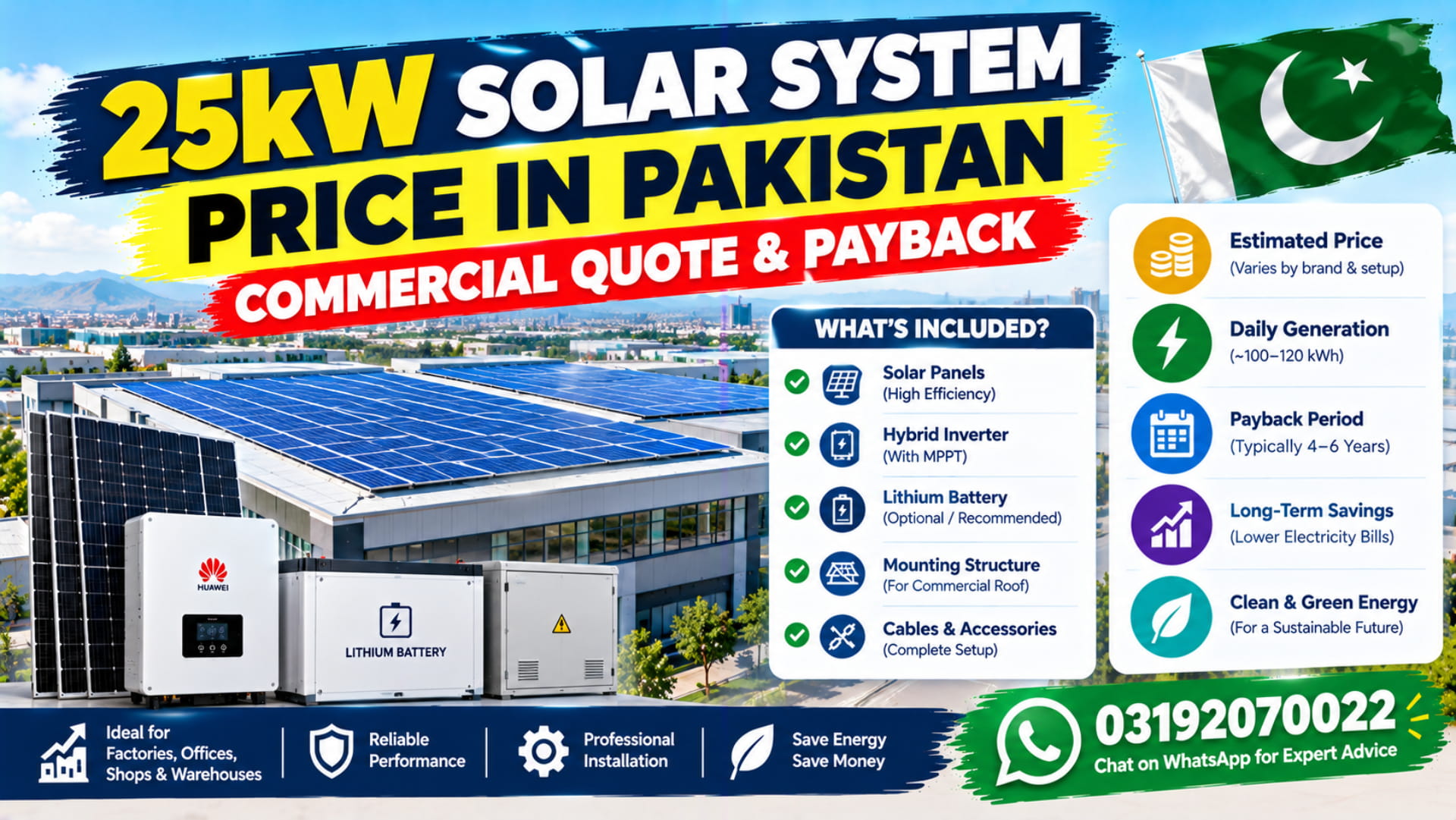
A 25kW solar system is a commercial-scale installation, sitting above what a single household typically needs and squarely in the range of a small factory, warehouse, school, clinic, or retail building running on a three-phase connection. In Pakistan, a 25kW system typically costs Rs 2,800,000 to 3,600,000 installed, and the economics behind that number work differently from a home system because commercial buildings usually consume electricity during exactly the hours solar panels produce it.
This guide breaks the cost down by component, explains the three-phase and net billing details that only apply at this scale, and works through a realistic payback for a commercial site.
Why 25kW is a different category from a home system
A home system is usually sized against a single electricity bill and a single-phase domestic connection. A 25kW system almost always connects to a three-phase supply, because that is how commercial and industrial connections are wired, and the equipment, protection and balancing requirements step up accordingly. Most installers will not simply scale up a domestic design; the inverter configuration, cabling and protection all need to be engineered for three-phase loads from the start.
This is also the scale where commercial net billing tariffs, rather than domestic slab rates, start to matter, and where the payback math genuinely improves if the building uses power on a regular daytime schedule, which a shop, school or small factory typically does far more consistently than a house.
The itemised breakdown
| Component | Typical specification | Approximate cost (Rs) |
|---|---|---|
| Solar panels | 43 x 585W Tier-1 N-type panels (≈25.16kW array) | 1,100,000 – 1,250,000 |
| Inverters | Three-phase, either one central unit or multiple string inverters paralleled | 650,000 – 850,000 |
| Mounting structure | Steel or aluminium, engineered for the roof type and wind load | 180,000 – 250,000 |
| DC and AC cabling, breakers, surge protection, three-phase earthing | Full protection chain sized for commercial current levels | 220,000 – 300,000 |
| Net billing meter and commercial DISCO application | Bi-directional meter and commercial-category paperwork | 60,000 – 90,000 |
| Installation, commissioning and testing | Larger crew, structural work, load balancing across phases | 300,000 – 400,000 |
| Total, installed | 2,510,000 – 3,140,000 |
As with smaller systems, the real-world quote usually sits a little above the raw component sum once margin, site logistics and any structural reinforcement specific to the building are included, which is how the Rs 2,800,000 to 3,600,000 range at the top of this guide is reached.
One central inverter or several smaller ones?
At 25kW, installers typically choose between a single central three-phase inverter or several smaller string inverters working in parallel. Each has trade-offs.
A single central inverter is simpler to install and monitor, and often cheaper per installed kW, but if it fails, the entire system goes offline until it is repaired or replaced.
Multiple string inverters, for example three 8kW units, cost a little more upfront but mean a single inverter failure only takes out a third of the system rather than all of it, and different roof sections with different orientations can be managed independently. For a business that depends on its solar offset every day, this redundancy is often worth the extra cost. Our hybrid inverter price in Pakistan guide covers the broader differences between inverter types and configurations if backup power is also part of the plan.
Three-phase balancing matters
A three-phase system needs its panels and inverter output balanced reasonably evenly across all three phases. An installer who simply connects everything to whichever phase is convenient can leave the system drawing unevenly, which both reduces how efficiently the solar output offsets the bill and can trip protection on the overloaded phase. Ask your installer directly how the array will be split across phases, and confirm the inverter configuration accounts for this at the design stage rather than being adjusted after installation.
Commercial net billing and why the payback is often better
Under current net billing rules, electricity you generate and use yourself is valued at your full tariff rate, while anything exported to the grid is bought back at a much lower rate, roughly Rs 8 to 11 per unit against a typical consumption-side tariff of Rs 40 to 60 per unit. Commercial and industrial tariffs vary by category and connection size, so confirm your exact rate with your DISCO or your electricity bill rather than assuming the domestic figure applies.
What makes a 25kW system attractive for a business is timing. A factory, warehouse or shop that operates roughly 9am to 6pm consumes most of its electricity during exactly the hours a 25kW array produces its output, which means a much higher share of generation is self-consumed at the full tariff rather than exported at the lower buyback rate. A house that is empty all day exports far more of what it generates, which is why commercial payback at this scale often beats residential payback on a like-for-like basis.
Roof and space requirements
A 25kW array of 585W panels needs roughly 110 to 130 square metres of usable roof or ground space, depending on panel spacing, walkways and any shading obstructions such as water tanks, HVAC units or parapets. Industrial roofs in areas like SITE and Korangi often have ample flat space but may need a structural assessment, since not every roof built decades ago was designed to carry an additional point load across its full span. Confirm the roof’s load-bearing capacity before committing to a layout, and budget for any reinforcement as part of the structure line item above.
A worked payback example
A small garment workshop in Karachi runs mainly during daylight hours and has an average monthly commercial electricity bill of around Rs 180,000, with most of its load falling between 9am and 7pm. A 25kW system installed at Rs 2,950,000, producing roughly 100 to 125 units a day depending on season, offsets a large share of that daytime consumption directly at the full commercial tariff.
If the system offsets roughly Rs 95,000 to 110,000 of the monthly bill through direct self-consumption, with a smaller amount earned from any surplus exported at the buyback rate, the system pays back in roughly two and a half to three years, assuming consistent operating hours and no major change in tariff structure. A business that runs a second shift into the evening, drawing more power after sunset, will see a longer payback, since more of its consumption falls outside solar hours.
Financing and depreciation
Commercial buyers often have financing and tax options that are not available to homeowners, including asset depreciation and, depending on current policy, incentives tied to renewable energy investment. These rules change and depend on your business structure, so treat this as a prompt to ask your accountant or tax advisor rather than firm advice. On the financing side, our solar loan EMI calculator guide explains how to weigh a monthly instalment against the expected saving, which applies to a commercial loan just as much as a residential one.
Maintenance at commercial scale
A 25kW system is large enough that most businesses benefit from a maintenance contract rather than ad hoc cleaning and checks. Dust accumulates faster in industrial areas with heavier vehicle traffic and nearby construction, and even a few percent of lost output on a system this size represents a meaningful rupee amount every month. Ask whether your quote includes a maintenance or annual service contract, and if not, budget separately for regular panel cleaning and an annual inspection of connections, inverter performance and structural integrity.
How long installation and approval actually take
A commercial system at this scale is not an overnight job. From signed order to full commissioning, a realistic timeline runs six to ten weeks: procurement and delivery of panels and inverters, structural assessment and any reinforcement, a crew of several days for mounting and wiring, then the DISCO’s own process for commercial net billing approval, which includes the bi-directional meter installation and inspection. Commercial applications sometimes move slower through a DISCO than domestic ones simply due to the connection category and the paperwork involved. Build this timeline into your planning rather than assuming the system will be exporting and offsetting the bill within days of the crew finishing on-site, and ask your installer for a written schedule with milestones rather than a single completion date.
What changes the price up or down
Roof type and condition. A flat concrete industrial roof in good structural condition costs less to mount on than one needing reinforcement or a ground-mounted structure on unused land.
Inverter configuration. A single central inverter is typically cheaper than a multi-inverter setup, but trades away redundancy, as covered above.
Panel tier. Tier-1 N-type panels cost more upfront than lower-tier alternatives but degrade more slowly over a 25-year system life, which matters more at commercial scale simply because of the larger investment at stake. The difference is explained in our A-grade vs B-grade solar panels guide.
Distance and site access. A site far from the supplier’s base, or with difficult crane or material access, adds real logistics cost that a vague quote sometimes leaves out.
Backup requirements. If any critical load, such as refrigeration, security systems or production equipment, needs to keep running through outages, a hybrid configuration with battery backup adds cost. Battery pricing varies by chemistry, brand and capacity and moves with the market, so WhatsApp us now for the latest price of the battery at 03192070022 rather than relying on a quoted number that may be outdated.
Red flags in a commercial quote
No mention of three-phase balancing. If the quote does not specify how the array will be split across phases, ask directly before signing.
A single combined price with no itemised breakdown. At this scale, every major line item, panels, inverter configuration, structure, protection, paperwork and installation, should be listed separately.
No structural assessment for the roof. A quote that skips evaluating whether your roof can carry the array’s weight is a quote that has skipped a step that matters at this scale.
Vague panel or inverter brand. “25kW of panels” with no stated brand or tier, and no inverter model named, makes it difficult to verify what you are actually paying for before installation. The sizing logic that applies to smaller homes is covered in our 5kW solar system price and 10kW solar system price guides if you want to compare how costs scale between residential and commercial sizes.
Getting a quote through BuySolars
Send us your average monthly commercial bill, your operating hours, your roof type and dimensions, and whether any load needs backup power, and we will return a full itemised commercial quote rather than a single headline figure. We supply panels, inverters and batteries with nationwide delivery, and current stock is on our products page.
WhatsApp 03192070022 for an itemised 25kW commercial solar quote.
Typically Rs 2,800,000 to 3,600,000 installed, depending on inverter configuration, roof type and site access.
Often yes, because businesses tend to consume power during the same daylight hours solar panels produce it, raising self-consumption.
Roughly 110 to 130 square metres, depending on panel spacing and any shading obstructions.
Several smaller inverters cost a little more but avoid a single point of failure taking the whole system offline.