
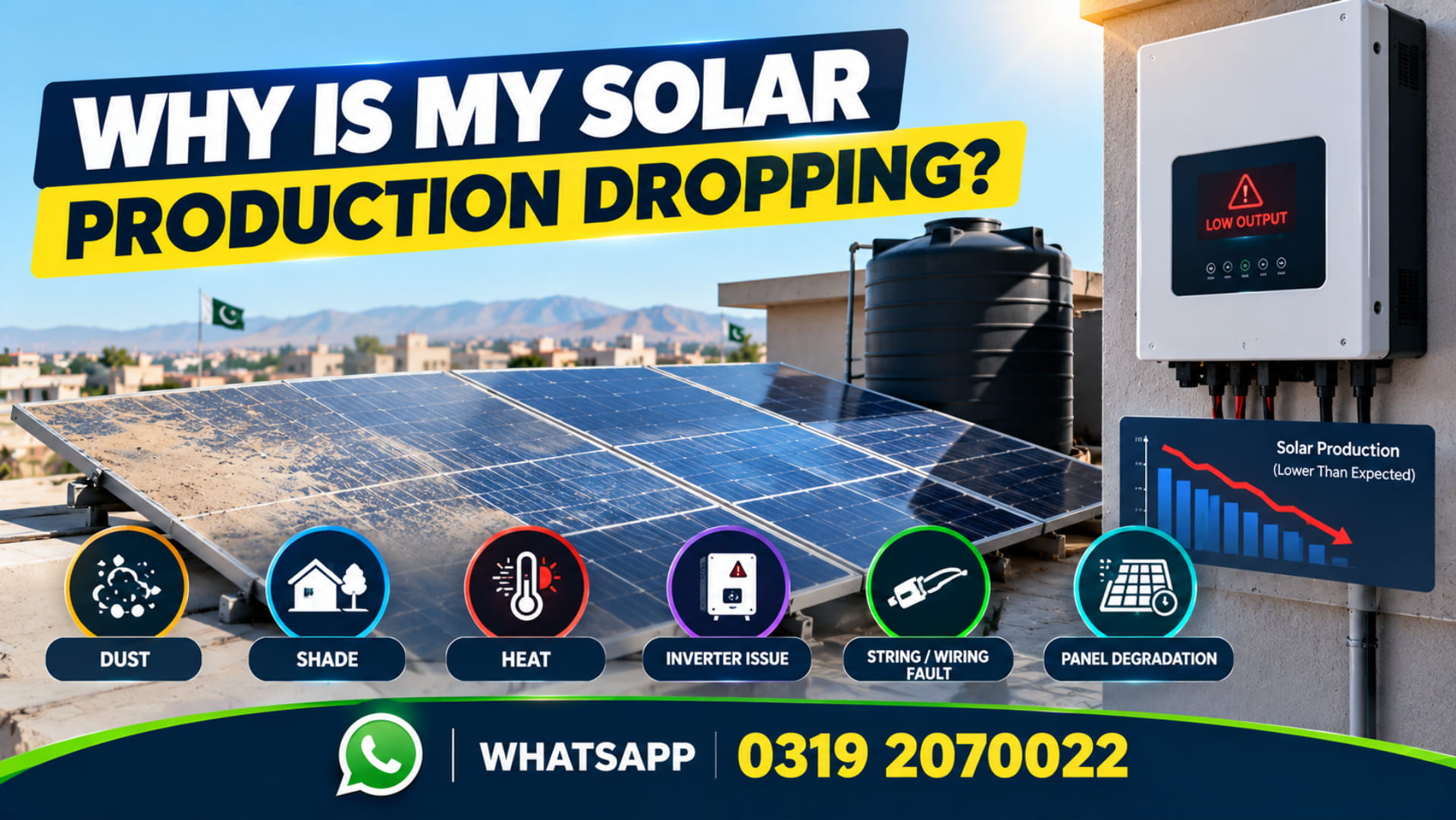
Before troubleshooting anything, ask one question first: are you comparing this month against last month, or against the same month last year? Almost every “my production dropped” concern that turns out to be nothing traces back to comparing against the wrong baseline, since solar output in Pakistan swings naturally through the year, and a drop from a peak summer month to a monsoon month looks alarming even on a perfectly healthy system.
That said, real faults do exist and do cause real drops, separate from seasonal swing. The rest of this guide separates the two, starting with what is normal, then working through what actually points to a problem.
First, check against the right baseline
Peak sun hours in Pakistan vary meaningfully by season and region, and a system’s monthly output should be judged against the same month a year earlier, not the month before it.
| Period | Typical daily peak sun hours | What this means for output |
|---|---|---|
| Summer (April–June) | 6 – 7.5 hours | Highest output of the year, long clear days |
| Monsoon (July–September) | 4 – 5.5 hours | Meaningful dip from cloud cover, sometimes for days at a stretch |
| Autumn (October–November) | 5 – 6 hours | Recovering, still strong |
| Winter (December–February) | 4 – 5 hours | Lowest output of the year, shorter days, lower sun angle |
A system producing thirty percent less in August than it did in May has not developed a fault. It is behaving exactly as expected. The comparison that actually matters is this August against last August. If that comparison shows a real, unexplained gap, move on to the causes below.
The most common non-fault causes
Dust and soiling. This is, by a wide margin, the most frequent reason for output that looks lower than expected without anything actually being broken. An unwashed panel can lose five to fifteen percent of its output, and in dustier Pakistani cities that number climbs the longer cleaning is skipped. If your last wash was more than a month ago, this is the first thing to rule out, and it is the cheapest fix on this entire list.
New shading. A tree that has grown taller, a neighbouring building that went up recently, or even a water tank or antenna installed nearby can cast a shadow across part of the array that was not there when the system was installed. Because panels in a series string are electrically linked, shading even a small section of one panel can drag down the output of the entire string disproportionately, not just the shaded panel itself. Bypass diodes limit this damage but do not eliminate it. Walk the roof at different times of day and check whether a shadow now falls somewhere it did not before.
Monsoon cloud cover. Beyond the seasonal average, monsoon season can bring several consecutive overcast or rainy days that suppress output well below even the reduced monsoon baseline. This resolves on its own once clear days return and is not something to chase as a fault.
Normal panel degradation. Every panel loses a small amount of output every year, by design and by physics, not by failure. N-type panels typically degrade around 0.4 to 0.55 percent a year after the first year, while older P-type panels degrade somewhat faster. Over one or two years this is essentially invisible; it becomes noticeable only over a much longer horizon. The full degradation curve and what it means for output over 25 years is covered in our solar panel kitne saal chalta hai guide, and the underlying technical difference between N-type and P-type degradation rates is explained in our N-type vs P-type panels explained guide.
Causes that actually point to a fault
Loose or corroded DC connections. A connection that has loosened over time, or corroded faster than expected in coastal humidity, adds resistance to the circuit and bleeds off power as heat rather than delivering it. This tends to cause a gradual decline rather than a sudden one, which makes it easy to mistake for normal degradation until it is checked directly. Correct connection quality at installation, including proper earthing and weatherproofing, reduces how often this happens, covered in our solar panel installation in Karachi guide, and the same principles apply nationwide.
A failed bypass diode or a microcracked cell. Physical damage from hail, a dropped tool during maintenance, or a manufacturing defect that was never caught can cause a specific panel or section of a panel to underperform while the rest of the array looks normal. This usually shows up as one string producing noticeably less than an identical string elsewhere on the same roof, which is a useful diagnostic signal on its own.
Inverter thermal derating. Inverters deliberately reduce their own output when internal temperature climbs too high, as a protection measure rather than a failure. An inverter installed in a poorly ventilated space, in direct sun, or with dust-clogged vents can derate itself during the hottest part of the afternoon, exactly when output should be at its peak. This often gets blamed on the panels when the actual bottleneck is the inverter protecting itself. Fault and warning codes that can accompany this, including overload and bus voltage conditions, are explained in our inverter F01, F07, F22 error code guide.
MPPT tracking or controller issues. The maximum power point tracking stage is responsible for extracting the most power available from the panels at any given moment. A controller that has developed a fault, or firmware that is not tracking correctly, can leave real power on the table without throwing an obvious alarm, which makes it one of the harder causes to spot without directly comparing measured output against expected output for the conditions.
String imbalance. Mixing panels of different ages, orientations, or slightly different specifications within the same series string means the weakest panel effectively limits what the whole string can deliver, since current in a series string is constrained by its weakest link. This is more of a design issue from installation time than something that develops suddenly, but it becomes more noticeable as one part of the array ages faster than another.
A billing confusion worth ruling out first
One thing that is not actually a production drop, despite feeling like one: since NEPRA’s net billing rules took effect, exported units are credited at a lower rate than imported units are charged, which can make your bill look worse even when your system’s actual generation has not changed at all. If what changed is your bill rather than your inverter’s logged generation figures, the system may be working exactly as before, and the real change is in how self-consumption versus export is now valued. Check the inverter’s own generation log against last year’s log before assuming the panels themselves are underperforming.
How to actually check which one you have
Work through this in order rather than guessing. Pull your inverter’s monthly generation log and compare it against the same month last year, not last month, using the seasonal table above as a sanity check. Confirm when the panels were last washed, and if it has been more than four to six weeks, wash them before troubleshooting anything else. Walk the installation at different times of day and look for new shadows that were not present before. Check the inverter’s display or app for any derating indicator, fault code, or temperature warning during the hottest hours. If your installer or a technician can measure output per string with a clamp meter, compare strings against each other, since a healthy string should produce close to what an identical string on the same orientation produces. Only after these checks come up clean should physical component failure, a diode, a cell, a controller become the leading explanation.
When to call a technician
Dust, seasonal swing, and new shading are all things you can identify and largely fix yourself. A persistent gap between one string’s output and another, a fault or derating code that will not clear, or a drop that shows up suddenly rather than gradually and does not correlate with weather or shading are all situations worth having a technician inspect directly, since they may point to a hardware fault that needs proper testing to confirm.
Reducing the swings you can control
You cannot control monsoon cloud cover or the length of a winter day, but several of the causes above are within your control. A cleaning schedule of every two to four weeks keeps dust losses to a minimum. Trimming trees or flagging new construction early prevents shading losses from creeping up unnoticed. Keeping the inverter in a shaded, ventilated location reduces how often thermal derating kicks in during peak summer afternoons. And getting the system sized correctly from the start, matched to your roof and load rather than the bare minimum, is covered in our 10kW solar system price in Pakistan guide if you are evaluating whether your current array is actually adequate in the first place.
A note on suspect panels
If a specific panel or string has underperformed since day one rather than declining gradually, it is worth confirming the panels are genuine and correctly graded rather than assuming a later fault. B-grade, relabelled or physically compromised panels can underperform from the very start, and the checks for telling these apart from genuine A-grade stock are laid out in our how to spot fake solar panels guide.
Getting help through BuySolars
If you have compared against the right baseline, ruled out dust and shading, and checked your inverter for derating or fault codes and the gap still does not add up, send us your system size, installation date, and what you found over WhatsApp. A photo of the inverter’s generation log alongside the same period from last year is usually the single most useful thing you can share for a fast diagnosis.
We also stock genuine, documented panels, hybrid inverters and structure components with nationwide delivery, in case the diagnosis points to a part that needs replacing. Current stock is on our products page.
WhatsApp 03192070022 with your generation log and system details for a fast, accurate diagnosis.
Yes. Peak sun hours fall to roughly four to five and a half hours a day during monsoon compared with six to seven and a half in summer, and extended cloud cover can push output lower still for several days at a time. This is expected, not a fault.
Commonly five to fifteen percent, and more the longer cleaning is skipped. It is the single most common reason for output that looks lower than expected without any actual hardware problem.
Yes, more than most people expect. Because panels in a series string are electrically linked, shading part of even one panel can drag down the output of the entire string, not just the shaded section, due to how current flows through a series circuit.
Since NEPRA’s net billing rules took effect, exported units are credited at a lower rate than imported units are charged. A worse bill does not necessarily mean lower generation, it can simply reflect how self-consumption and export are now valued differently.
Check the inverter’s display or app during the hottest part of the afternoon for a temperature warning or derating indicator. If output dips specifically during peak heat and recovers as it cools, the inverter protecting itself is the likely cause rather than the panels.
When the drop appears suddenly rather than gradually, when one string clearly underperforms an identical string nearby, or when a fault code persists after a restart. These point toward a hardware issue that needs proper measurement to confirm.