
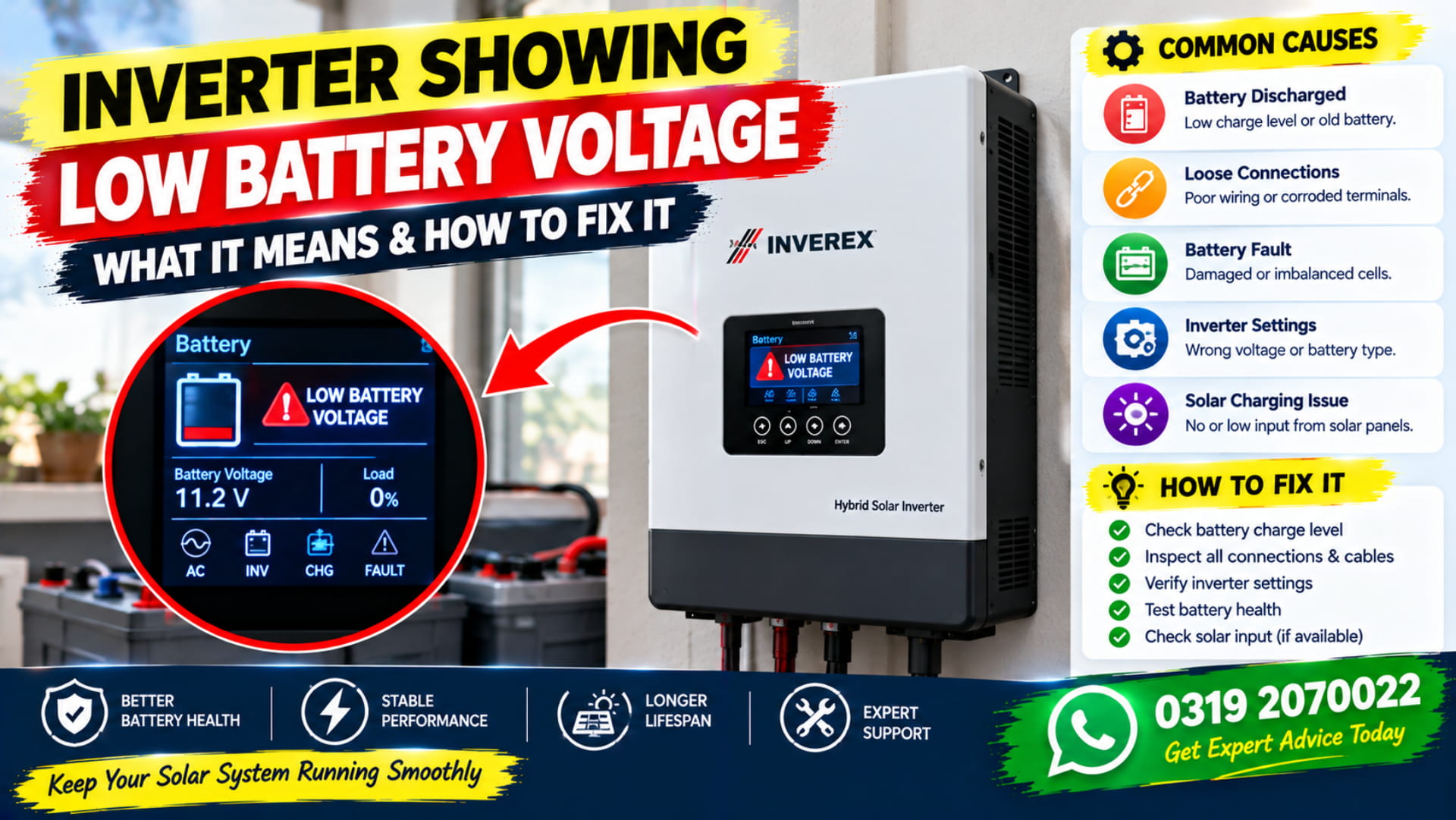
A low battery voltage warning is one of the most common things an inverter display shows, and it covers a wide range of situations: a battery that is genuinely running low after a long outage, a reading that looks low only because something heavy just switched on, a battery that has quietly aged past its usable life, or a setting mismatch making a perfectly healthy battery look empty.
Before assuming the worst, it helps to understand one thing: the number on the screen is not always the number that matters.
Resting voltage and loaded voltage are not the same number
Every battery’s voltage drops the instant current is drawn from it, because of its own internal resistance. A battery sitting idle might read 13.2V, then dip to 12.6V the moment a one-ton AC compressor starts, then climb back up within seconds once the surge passes. Both readings are correct. They just describe different moments.
Most inverters display the loaded voltage, the number under whatever current is flowing right now, not the resting figure. This matters because a battery that looks alarmingly low during a heavy load may be completely normal once that load is removed. Before treating a low reading as a fault, check whether it coincides with something switching on, and whether it recovers once that load stops.
A quick reference before you dig further
| What you observe | What it most likely points to |
|---|---|
| Voltage dips only when a heavy appliance starts, then recovers | Normal loaded voltage sag, not a fault |
| Voltage stays low all evening, climbs back up after sunrise | Genuine overnight discharge, charging is working fine |
| Voltage stays low even in strong midday sun | Charging-side problem, not the battery itself |
| Reading at the inverter is much lower than at the battery terminals | Loose or corroded connection, not a weak battery |
| Cutoff reached earlier each week under a similar load | Battery losing capacity with age |
| Warning appears daily even with light, steady use | Undersized battery or a settings mismatch |
Use this table to narrow things down quickly, then confirm with the checks later in this guide before deciding on a fix.
Lithium batteries behave differently from lead-acid, and this confuses a lot of people
If your system uses a lithium (LiFePO4) battery, its voltage curve is unusually flat. Most of its usable capacity sits within a narrow voltage band, and the voltage only drops sharply once the battery is genuinely close to empty. A lead-acid or tubular battery, by contrast, slopes down more gradually as it discharges, giving a clearer early warning.
The practical effect: a lithium system can look perfectly fine for hours and then show a low-voltage warning fairly suddenly, because the flat part of the curve just ended. This is normal chemistry, not a fault, and it is one reason relying on voltage alone to judge state of charge is less reliable for lithium than tracking the percentage or state-of-charge figure the BMS reports, when your inverter shows one. The sizing and discharge behaviour that explains this is covered in our lithium battery guide.
The most common real causes, in order
The battery is genuinely discharged. Long loadshedding, several cloudy days in a row, or simply more consumption than the panels replaced that day will all bring a battery down toward its low cutoff. This is the ordinary, expected reason for the warning, and the fix is to reduce load and let it recharge, not to treat it as damage.
The battery is undersized for the load it carries. If the bank is regularly pushed close to empty every single day, the low-voltage warning becomes a near-daily event rather than an occasional one. That is a sizing problem rather than a battery problem, and the method for working out the right capacity against your actual appliance list is in our solar ke liye kitni battery chahiye guide.
Charging is not keeping up. If the panels are dusty, shaded, or the charge controller has a fault, the battery may never fully recover between discharge cycles, so it starts each evening a little lower than the day before until it eventually trips the low-voltage warning. If the warning shows up alongside output that never seems to replenish the battery during sunny hours, the fault may be upstream of the battery entirely, which our solar panel not charging battery guide walks through.
A loose or corroded connection is causing a false low reading. Resistance at a terminal or connector causes voltage to drop under load even when the battery itself is healthy at its own posts. This produces exactly the same symptom as a weak battery, a reading that sags hard the moment load is applied, but the fix is cleaning and tightening a connection rather than replacing anything. This is more common in coastal Karachi, where corrosion sets in faster, and good connection practice at installation is covered in our solar panel installation in Karachi guide.
The inverter’s battery type or voltage settings are wrong. If the inverter is configured for a different chemistry than what is actually installed, or the low-voltage cutoff is set too high, it can flag a perfectly good battery as low. This is especially easy to get wrong when a lead-acid system is upgraded to lithium and the settings are never updated to match.
The battery is genuinely ageing. A battery that used to hold voltage comfortably under load but now sags noticeably, recovers more slowly, or reaches the low-voltage cutoff earlier each day than it did a year ago, is likely losing usable capacity. This is a normal part of battery life rather than a sudden failure, and it becomes a replacement decision rather than a troubleshooting one.
One weak cell or module is dragging the whole reading down. In a bank built from multiple cells or parallel units, one that has degraded faster than the rest can pull the overall voltage down under load even if the others are fine. This usually needs a technician with the right test equipment to isolate.
A standby drain is quietly emptying the battery overnight. Routers, standby electronics, security cameras and the inverter’s own control circuitry draw a small continuous current even when nothing major is switched on. Over a long outage with little sunlight, this parasitic load alone can be enough to push the voltage down to the warning threshold, especially on an undersized battery.
Fault codes that can accompany a low-voltage warning
Some inverters pair a low-voltage condition with a specific fault code rather than a plain warning message, and a battery under-voltage fault is one of the more common codes seen on Voltronic-style firmware used by many Pakistani-market hybrid inverters. If your display is showing a numbered code alongside the warning, our inverter F01, F07, F22 error code guide explains how to read codes of that kind, even though the specific battery-voltage code may differ from the three covered there, the same principle of checking your exact model’s manual applies.
How to tell which of these you actually have
Work through this in order rather than guessing.
Check the timing. Does the low reading appear only when something heavy switches on, and recover once it switches off? That points to loaded voltage sag, which is often normal, not a fault.
Measure at the battery terminals directly, with a multimeter, and compare that figure with what the inverter displays at the same moment. A meaningful gap between the two points to a connection problem between the battery and the inverter rather than the battery itself.
Watch what happens once the sun comes up. If the voltage climbs steadily through the morning as expected, charging is working and the battery was simply discharged overnight. If it stays flat or barely moves despite good sun, the charging side needs investigating.
Compare today against a few weeks ago. If the battery now hits its low-voltage cutoff earlier in the evening than it used to, under a similar load, that is the clearest sign of a battery losing capacity with age rather than anything else on this list.
Check the inverter’s battery type setting against what is actually installed, and confirm the low-voltage cutoff matches the battery manufacturer’s recommended figure rather than a generic default.
A worked example
A household in Karachi starts seeing a low-battery warning most evenings around 9pm, a time the system used to run past midnight without trouble. The owner first checks the timing: the warning is not tied to any single appliance switching on, it simply creeps up gradually through the evening, which rules out ordinary loaded voltage sag.
Next, they check whether it recovers after sunrise. It does, climbing back to a healthy resting voltage by mid-morning on a sunny day, which rules out a charging-side fault, since the panels are clearly replenishing the battery when the sun is out.
They then compare today’s cutoff time against three months ago under a similar evening load, and find the gap has shrunk from roughly five hours of backup to about three. Measuring at the battery terminals directly matches what the inverter shows, ruling out a connection problem. Taken together, this pattern points to the battery losing usable capacity with age rather than any setting or wiring issue, and the household plans a replacement rather than continuing to chase a fault that is not there.
What to do once you know the cause
If it is genuine discharge, reduce non-essential load and let the system recharge; no repair is needed. If it is a sizing problem, work out a larger capacity against your real load rather than continuing to run the bank to its limit every day. If it is a connection fault, clean and re-tighten every terminal between battery and inverter, checking for corrosion especially near the coast. If it is a settings mismatch, correct the battery type and cutoff voltage in the inverter menu to match the installed battery. If charging is the real bottleneck, trace that separately rather than treating the battery as faulty. If the pattern points to genuine ageing, plan for replacement rather than waiting for a full failure during the next long outage.
Battery prices vary by chemistry, brand and capacity, and move with the market, so WhatsApp us now for the latest price of the battery at 03192070022 if replacement turns out to be the answer.
Preventing nuisance low-voltage warnings
Size the battery against your actual daily load with a realistic margin, rather than the bare minimum. Avoid routinely discharging the battery to its limit every single day, since this both triggers more warnings and shortens the battery’s working life. Keep every terminal and connector clean and tight, with an annual check that is more frequent in humid coastal conditions. And make sure the inverter’s battery type and voltage settings are confirmed correct at installation and rechecked if the battery is ever replaced or upgraded.
Getting help through BuySolars
If you are unsure whether your reading reflects a real problem, send us the inverter and battery model, the voltage shown, whether it recovers once load is removed, and how the pattern has changed over recent weeks, and we can help you work out which of the causes above applies. We supply documented lithium batteries and hybrid inverters with nationwide delivery, and current stock is on our products page.
WhatsApp 03192070022 with your voltage reading and battery details for a quick diagnosis.
Often because the reading is taken under load, which is always lower than resting voltage, or because a loose connection is causing voltage to sag under current.
Yes. Lithium batteries have a flat discharge curve, so voltage stays steady for most of the discharge and then falls quickly once the battery is genuinely near empty.
Compare how early it reaches the low-voltage cutoff today versus a few weeks ago under a similar load. A battery reaching cutoff progressively earlier is losing capacity.
Yes. Resistance at a loose or corroded terminal drops voltage under load even when the battery itself is healthy at its own posts.
No. Doing this daily shortens battery life and increases how often you see the warning. Size the battery with margin so it rarely needs to reach that point.