
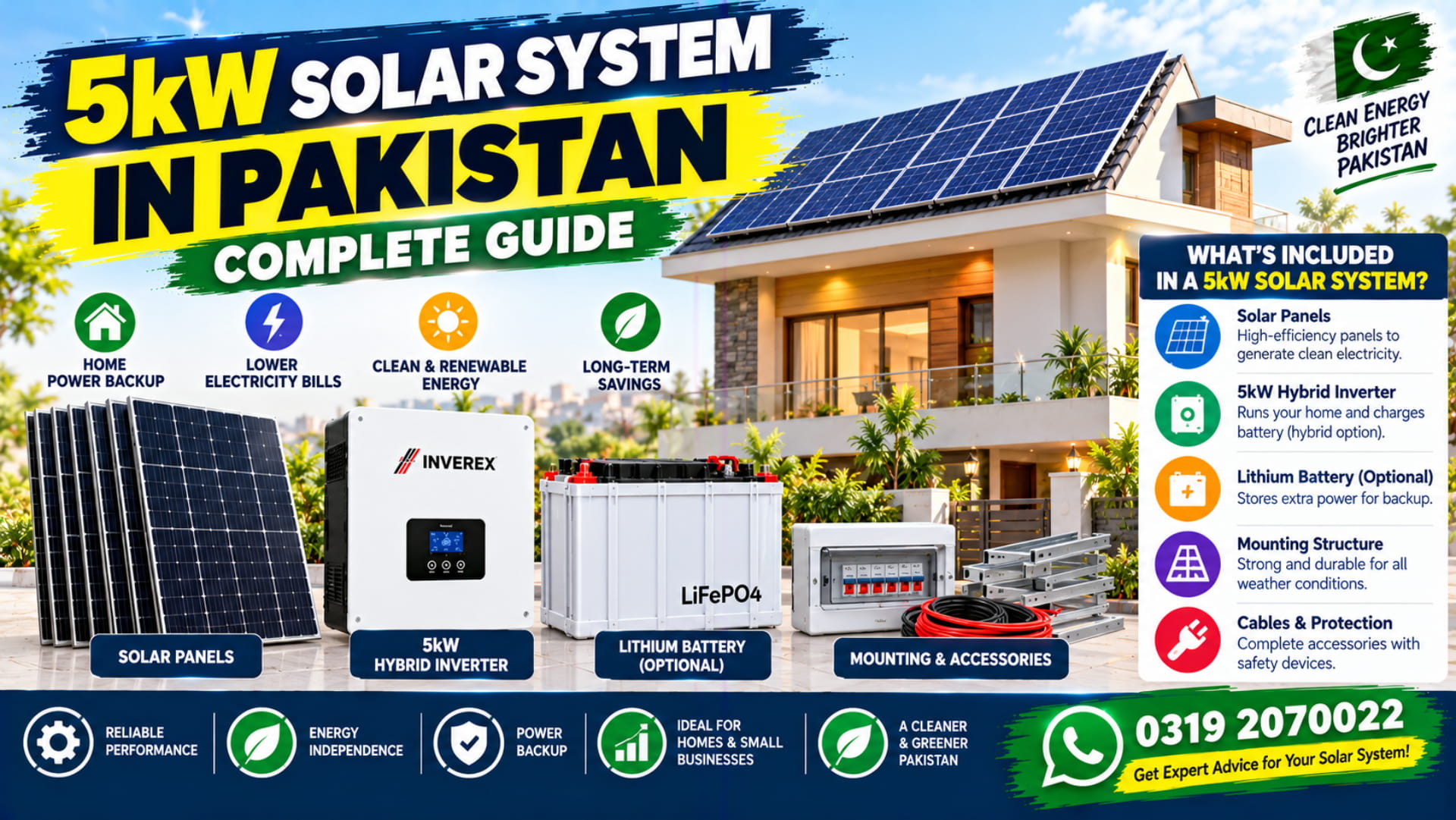
A 5kW solar system in Pakistan typically costs Rs 580,000 to 750,000 installed on-grid, or Rs 620,000 to 820,000 and above as a hybrid system with battery backup. Those headline ranges hide the part that actually matters when you’re comparing quotes: what each rupee is buying. This guide breaks a 5kW system down component by component, so you can tell an honest quote from one that is missing something, and see where the money genuinely goes.
Prices move with the dollar, shipping costs and container arrivals, so treat every figure here as a planning range rather than today’s exact number, and confirm current rates before committing.
What “5kW” actually describes
The 5kW figure usually refers to the panel array’s rated capacity, though some sellers quote it as the inverter’s rating instead, which is one reason two “5kW system” quotes can differ substantially. Always ask whether the number refers to panels, inverter, or both, since a genuine 5kW system needs the components matched to each other rather than just the headline figure.
In Karachi and most of Pakistan, 5kW of panels produces roughly 20 to 25 units (kWh) a day on average across the year, more in summer, less in the monsoon and winter. That output is what the cost below is actually paying to generate.
The itemised breakdown: on-grid system
| Component | Typical specification | Approximate cost (Rs) |
|---|---|---|
| Solar panels | 9 x 585W Tier-1 N-type panels (≈5.26kW array) | 230,000 – 255,000 |
| On-grid inverter | 5kW rated, with net billing export capability | 140,000 – 180,000 |
| Mounting structure | Galvanised steel or aluminium, engineered for wind load | 35,000 – 50,000 |
| DC and AC cabling, breakers, surge protection, earthing | Full protection chain, not just panel-to-inverter wiring | 40,000 – 60,000 |
| Net billing meter and DISCO application assistance | Bi-directional meter and paperwork handling | 25,000 – 35,000 |
| Installation labour and commissioning | Site work, testing, handover | 50,000 – 70,000 |
| Total, on-grid | 520,000 – 650,000 |
Real-world quotes usually land a little above this raw component sum once a margin, transport to site and any site-specific structural work are added, which is how the headline range of roughly Rs 580,000 to 750,000 is reached.
Why panels are no longer the biggest line item
A few years ago, panels dominated a solar quote. Panel prices have fallen faster than inverters, structure or labour, so today the panels are often a third or less of the total installed cost, not the majority. This matters when comparing quotes: a seller advertising unusually cheap panels while staying vague on the inverter brand, structure material or cabling gauge may be recovering the discount elsewhere, or cutting corners on the parts that actually protect the system.
Adding a hybrid inverter and battery backup
If you want the system to keep running fans, lights and essential loads through load shedding, you need a hybrid inverter and a battery rather than an on-grid unit, which shuts down automatically whenever the grid fails. The differences between on-grid, hybrid and off-grid equipment are covered in detail in our hybrid inverter price in Pakistan guide.
Swapping the on-grid inverter for a 5kW-class hybrid unit typically adds Rs 20,000 to 60,000 over the on-grid inverter price above, depending on brand and features such as parallel capability or a built-in transfer switch.
Battery capacity is sized against what you actually need to run during an outage, not guessed at, and the method for working that out is in our solar ke liye kitni battery chahiye guide. Because battery and lithium storage prices move quickly and vary by chemistry, brand and capacity, WhatsApp us now for the latest price of the battery at 03192070022 rather than relying on a number that may already be out of date by the time you read this.
With a hybrid inverter and a modest battery added, the realistic installed total for a 5kW system moves into the Rs 620,000 to 820,000 range quoted at the start of this guide, with the exact figure depending heavily on the battery capacity chosen.
What changes the price up or down
Panel brand and wattage. A 585W Tier-1 N-type panel costs more per watt than a lower-tier or older P-type panel, but degrades more slowly and typically carries a longer warranty. The trade-offs are covered in our N-type vs P-type panels explained guide.
Roof type and structure. A flat concrete roof with easy access costs less to mount on than a sloped tin roof, a roof needing extra wind-bracing, or a site needing a ground-mounted structure.
Cable run length. A system with the inverter far from the panels or from the distribution board needs longer, heavier cable runs, which adds real cost that a lazy quote sometimes under-specifies.
Site distance and access. Karachi installations close to the supplier’s base cost less to service than a remote site, purely on logistics.
Inverter brand. A well-supported brand with a strong local service network commands a higher price than an unsupported import, and that premium is usually worth paying, since warranty support matters more over a 10-year system life than a small upfront saving.
What a 5kW system actually saves you
Under the current net billing rules, units you consume yourself are valued at your full slab tariff, typically Rs 40 to 60 per unit, while units exported to the grid earn only about Rs 8 to 11 per unit. A household that uses most of its solar output directly, running the washing machine, ironing and the air conditioner during daylight hours, sees a far better payback than one that is away all day and exports most of its generation.
At roughly 20 to 25 units a day, a 5kW system can offset a meaningful share of a household using Rs 25,000 to 45,000 worth of electricity a month, with the exact saving depending on how much of that use falls in daylight. At that range of saving, the payback on the on-grid total above typically falls between two and three years, before accounting for how the system performs across seasons, which our why is my solar production dropping guide explains in more detail for anyone tracking month-to-month output.
Red flags in a cheap quote
No stated panel tier or model. “585W panels” with no brand or tier specified can mean a lower-grade cell behind a correct-sounding wattage label. Our A-grade vs B-grade solar panels guide explains what separates the two and why the difference matters for 25-year performance, not just day-one output.
Vague or missing structure specification. “Mounting structure included” with no material, gauge or wind rating is a common place corners get cut, since this line item is invisible once the panels are on the roof.
No net billing paperwork included. If the DISCO application and bi-directional meter are not part of the quote, confirm who is handling that and what it costs separately, since a system that cannot be registered for net billing is exporting power for nothing.
An unusually low total with no component breakdown. Ask for every line item listed separately. A seller confident in their pricing will give you the breakdown without hesitation.
How a 5kW system compares to other common sizes
Sizing the system correctly matters more than chasing the lowest headline price, since an undersized system under-delivers on savings and an oversized one wastes money on capacity you export for very little return.
| System size | Typical daily output | Best suited to |
|---|---|---|
| 3kW | 12 – 15 units | A small household with modest daytime use, light AC load |
| 5kW | 20 – 25 units | A mid-sized household running one AC unit and regular daytime appliances |
| 7.5kW | 30 – 38 units | A larger household or one running two AC units through the afternoon |
| 10kW | 40 – 50 units | A large house, a small business, or a household planning significant future load |
A 5kW system sits in the range most urban Pakistani households land on, large enough to make a real dent in a typical bill without the steeper upfront cost of a 10kW installation. If your bill or appliance list sits well outside the 5kW range, our 10kW solar system price in Pakistan guide and our sizing guide for a 120, 240 or 500 square yard house in Karachi can help you confirm the right size before you request a quote.
Financing a 5kW system
Not everyone pays the full amount upfront. Several banks and the manufacturer-backed schemes active in Pakistan offer instalment plans for solar purchases, and the right choice depends on comparing the monthly instalment against your expected monthly saving, not just the headline interest rate. Our solar loan EMI calculator guide walks through how to run that comparison so the loan genuinely pays for itself from the saving rather than adding a new monthly burden on top of a reduced electricity bill.
Costs that continue after installation
The itemised price above covers installation, not the small ongoing costs of running the system. Panels need washing every few weeks in dusty conditions, more often in Karachi, to avoid the output loss dust causes. An on-grid or hybrid inverter typically lasts 8 to 12 years before replacement, a cost worth budgeting for rather than being surprised by a decade in. If a battery is part of the system, its working life is usually shorter than the panels’, so factor a future replacement into your long-term budget rather than assuming the first battery lasts the system’s full 25-year panel life.
A worked example
A household in Karachi with an average monthly bill of Rs 32,000 wants a 5kW on-grid system. The itemised quote comes to panels Rs 245,000, inverter Rs 160,000, structure Rs 42,000, cabling and protection Rs 48,000, net billing paperwork Rs 28,000, and installation Rs 58,000, totalling Rs 581,000 before margin, landing at roughly Rs 640,000 installed. With most of their usage falling in daylight hours thanks to a daytime-heavy household, the system offsets close to Rs 22,000 of the monthly bill, giving a payback of just under two and a half years.
Getting a quote through BuySolars
Send us your average monthly bill, your roof type and whether you want on-grid or hybrid with backup, and we will return a full itemised quote rather than a single headline number. We supply panels, inverters and batteries with nationwide delivery, and current stock is on our products page.
WhatsApp 03192070022 for an itemised 5kW solar quote.
Roughly Rs 580,000 to 750,000 on-grid, or Rs 620,000 to 820,000 and above as a hybrid system with battery backup.
Typically 20 to 25 units a day on average, more in summer and less in winter and monsoon.
Panels are usually now under a third of the total installed cost. Inverter, structure, cabling and labour make up the rest.
On-grid pays back faster if outages are rare. Hybrid costs more upfront but keeps essential loads running during load shedding.
Typically two to three years, faster for households that use most of their solar output directly rather than exporting it.