
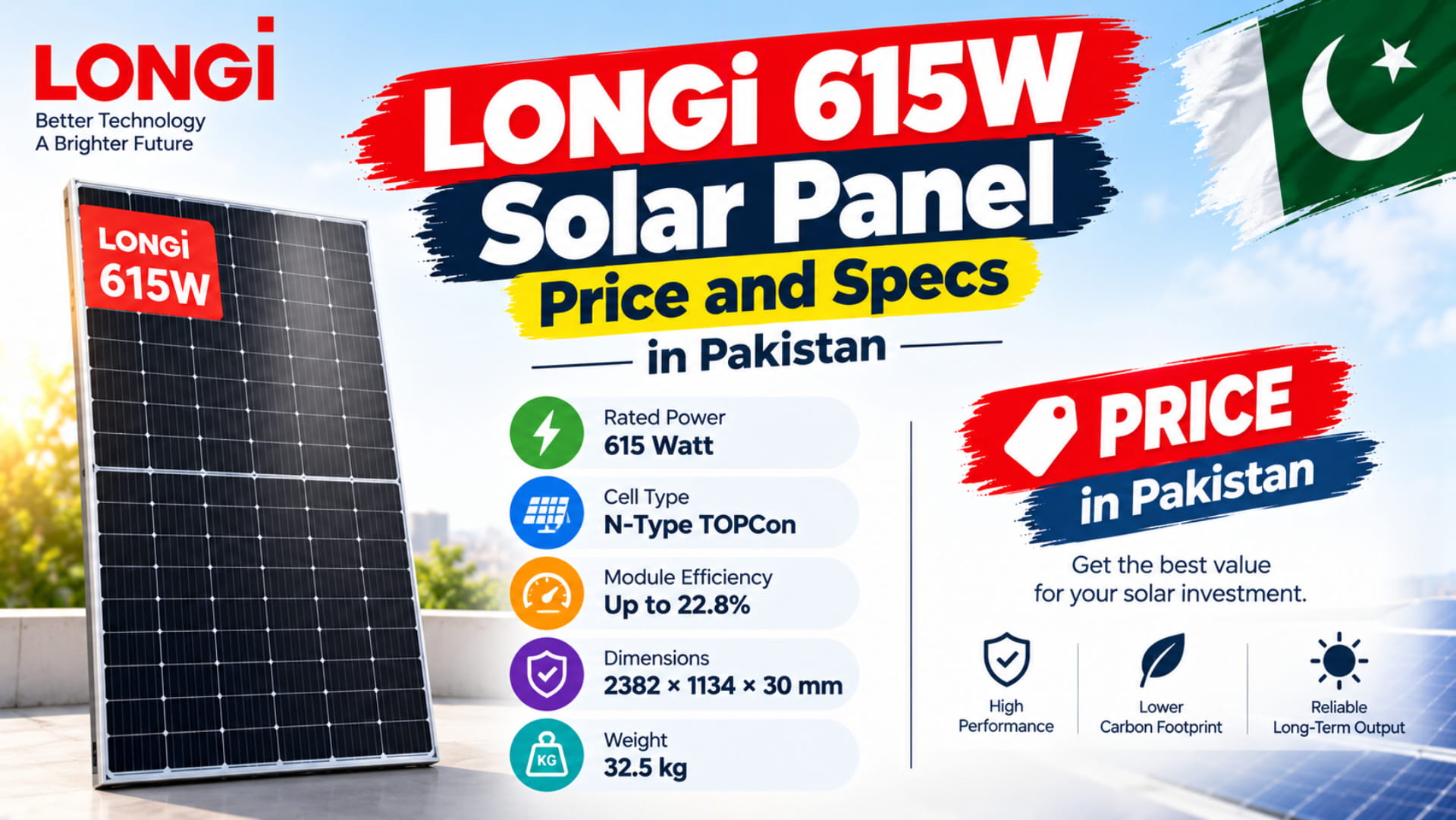
If you have been pricing out panels for a new system and kept seeing “615W” next to the Longi name, you have landed on one of the newer entries in Longi’s lineup for the Pakistani market: the Hi-MO 7 LR7-72HGD-615M. It sits between the mainstream 585W–600W class panels and the flagship Hi-MO X10 645W module, and it is being installed on a growing number of rooftops in Karachi, Lahore and Faisalabad because it gives a meaningful wattage bump without pushing the per-panel price into premium territory.
As of late 2026, Longi 615W panels are selling in Pakistan at roughly Rs 44–48 per watt, which works out to about Rs 27,000–29,500 per panel. Prices move with the dollar rate and import duty cycles, so treat this as a planning range rather than a quote — WhatsApp us at 03192070022 for the exact rate on the day you are buying.
This post covers what the panel actually is, its full datasheet, current pricing, how it compares to the Longi 645W and Jinko 720W, how many you need for common system sizes, and what to check before you buy.
What the Longi 615W Panel Actually Is
The 615W rating on a Longi panel in today’s market almost always points to one SKU: the LR7-72HGD-615M, part of the Hi-MO 7 series. A few things distinguish it from the other Longi wattage classes you will see quoted by dealers:
- N-type cells with back-contact technology. Longi calls this HPDC (a variant of its back-contact cell family). Unlike the standard front-contact N-type TOPCon cells used in most mid-tier panels, back-contact cells move the metal grid to the rear of the cell, so there is no visible busbar shading the front surface. This is part of why the panel reaches 22.8% efficiency despite using the same 72-cell, large-wafer format as cheaper panels.
- Bifacial glass-glass construction. The 615M has a glass front and a glass back rather than a polymer backsheet, which lets it capture reflected light off a light-coloured roof, white membrane, or gravel surface on the rear cell face. Longi rates the bifaciality factor at 80±5%.
- It is a different product line from the Hi-MO X10 645W. If you have already read our Longi 645W price and specs guide, note that the 645W module uses Longi’s newer HPBC 2.0 cell generation and a slightly larger format. The 615W Hi-MO 7 is the previous-generation back-contact platform — still genuinely Tier-1 and still N-type, just one step down in efficiency and price per watt from the X10 line.
In short: this is not a budget panel. It is a mainstream premium panel, positioned to give installers a wattage figure above 600W without the cost jump of the absolute top-tier modules.
Full Specifications: Longi LR7-72HGD-615M
| Specification | Value |
|---|---|
| Model | LONGi Hi-MO 7 LR7-72HGD-615M |
| Cell type | N-type back-contact (HPDC) |
| Number of cells | 72 (large-format, half-cut) |
| Maximum power (Pmax) | 615 W |
| Module efficiency | 22.8% |
| Open-circuit voltage (Voc) | 52.55 V |
| Short-circuit current (Isc) | 14.73 A |
| Voltage at max power (Vmp) | 44.44 V |
| Current at max power (Imp) | 13.84 A |
| Power temperature coefficient | -0.280%/°C |
| Voc temperature coefficient | -0.230%/°C |
| Isc temperature coefficient | +0.045%/°C |
| Bifaciality factor | 80% ± 5% |
| Dimensions | 2382 × 1134 × 30 mm (approx.) |
| Weight | 33.5 kg |
| Max system voltage | 1500 V DC |
| Max series fuse rating | 30 A |
| Power tolerance | 0 to +3% |
| Operating temperature | -40°C to +85°C |
| Mechanical load (front/back) | 5400 Pa / 2400 Pa |
| Hail impact rating | 25mm hailstone at 23 m/s |
| Product warranty | 12 years |
| Linear power warranty | 30 years |
| Certifications | IEC 61215, IEC 61730 |
The glass-glass build and the 30-year linear output warranty are the two numbers worth remembering when a dealer tries to sell you a cheaper backsheet panel “at the same wattage” — they are not the same product, and the warranty terms usually give that away immediately.
Current Pricing in Pakistan
| Panel count needed | Approx. cost (panels only, at Rs 44–48/W) |
|---|---|
| 1 panel (615W) | Rs 27,000 – 29,500 |
| 8 panels (4.92 kW) | Rs 133,000 – 145,000 |
| 13 panels (8.0 kW) | Rs 216,000 – 236,000 |
| 16 panels (9.84 kW) | Rs 266,000 – 290,000 |
| 24 panels (14.76 kW) | Rs 400,000 – 435,000 |
| 32 panels (19.68 kW) | Rs 533,000 – 580,000 |
These figures are for the panels alone — not the inverter, structure, cabling, lithium battery, or labour. For a complete installed hybrid system in the 10kW class, our baseline range across the cluster has consistently been Rs 1,050,000–1,350,000, and the panel brand you pick (Longi 615W vs. a cheaper P-type alternative) typically swings that total by 6–10%, not by double. As always, lithium battery pricing is never quoted as a flat number here because cell prices move week to week — WhatsApp us now for the latest price of the battery at 03192070022.
Where the Bifacial Gain Actually Shows Up
Longi’s 80% bifaciality rating sounds impressive on a spec sheet, but it is a lab figure measured under controlled rear illumination. On an actual Pakistani rooftop, the real-world gain depends almost entirely on what is underneath and around the panel:
- Elevated structure over a light-coloured roof or white waterproofing membrane: This is the best case for a bifacial panel, and the one most residential installs in DHA, Clifton, and similar housing schemes actually have. Expect a genuine 3–8% output bump over an equivalent monofacial panel, most noticeable in the winter months when the sun angle is lower and more light reaches the rear face indirectly.
- Ground-mounted systems over light gravel or white stone chips: This is closer to the manufacturer’s test conditions and can realistically add 8–15%, which is why bifacial panels are popular for ground-mount tubewell and commercial installations.
- Flush-mounted on a dark roof, or mounted with minimal rear clearance: The bifacial advantage largely disappears. If your structure sits the panel within a few inches of a dark concrete or bitumen roof, you are effectively paying a small premium for a monofacial panel with extra glass weight.
If you are not sure which situation applies to your roof, ask your installer specifically about mounting height and rear clearance before paying extra for a bifacial module over a monofacial one of similar wattage.
Longi 615W vs. Longi 645W vs. Jinko 720W
| Longi 615W (Hi-MO 7) | Longi 645W (Hi-MO X10) | Jinko 720W | |
|---|---|---|---|
| Cell type | N-type back-contact | N-type HPBC 2.0 | N-type TOPCon |
| Efficiency | 22.8% | Up to 23.9% | Up to 23.2% |
| Weight | 33.5 kg | ~33.5 kg | Heavier, larger format |
| Degradation (yr 2–25) | ~0.55%/yr | ~0.55%/yr | ~0.4–0.5%/yr |
| Price per watt | Rs 44–48 | Rs 44–48 (premium end) | Comparable, higher per-panel cost |
| Best fit | Balanced cost/performance, mid-size roofs | Roof-constrained installs needing max watts per slot | Large commercial roofs, fewer high-wattage panels |
None of these three is “wrong” — they solve slightly different problems. If your roof has plenty of space and you are optimising for the lowest all-in cost per kW, the 615W is usually the sensible middle choice. If you are trying to squeeze a specific kW target into a limited number of mounting slots, the 645W or 720W earns its higher per-panel price. For a deeper look at how Longi and Jinko panels specifically perform under Pakistani heat and dust conditions, see our Longi vs Jinko comparison.
How Many Longi 615W Panels You Need
| Target system size | Panels (615W each) | Actual array size |
|---|---|---|
| 3 kW | 5 | 3.08 kW |
| 5 kW | 8 | 4.92 kW |
| 8 kW | 13 | 8.0 kW |
| 10 kW | 16 | 9.84 kW |
| 15 kW | 24 | 14.76 kW |
| 20 kW | 32 | 19.68 kW |
| 25 kW | 41 | 25.2 kW |
Notice that a “10kW” system built from 615W panels actually lands at 9.84kW unless you go to 17 panels (10.45kW) — this rounding is completely normal in solar sizing and not something to worry about. If you are comparing quotes between installers, check the actual array wattage they are quoting, not just the number they wrote on the proposal. For a full breakdown of what else goes into a 10kW package beyond the panels, see our 10kW solar system price guide.
Worked example: an 8kW array for a mid-sized Karachi home
Take a household running two 1.5-ton inverter ACs, a fridge, lights, and occasional washing machine use — a common load profile for a 400–600 sq. yd house. Thirteen Longi 615W panels give an 8.0kW array. At 1kW of panels producing roughly 4–5 units/day on average across the year in Pakistan, that array should average somewhere around 28–36 units/day, with the top end reached in summer (June–August, 6–7.5 peak sun hours in Karachi) and the lower end in winter (December–January, 4–5 peak sun hours). Paired with an 8kW hybrid inverter and a lithium bank sized for evening backup, that is enough to run both ACs through the afternoon off solar directly and still bank surplus units for the morning load.
String Design Notes for Installers
The 615W panel’s Voc of 52.55V and Vmp of 44.44V matter for string sizing, especially in winter when open-circuit voltage rises as temperature drops:
- A string of 8 panels gives a nominal Voc around 420V at STC, which can climb close to 470–480V in cold morning conditions — check this against your inverter’s maximum DC input voltage (commonly 500–600V for mainstream hybrid inverters) before finalising string length.
- With Imp at 13.84A, most single-MPPT hybrid inverters in the 8–12kW class can comfortably handle two strings of this panel in parallel on one MPPT, but always confirm against the specific inverter’s MPPT current rating rather than assuming.
- Mixed orientation roofs (east/west split arrays) should go on separate MPPT inputs where the inverter has more than one, to avoid the lower-producing string dragging down the better one.
If your installer is quoting a string configuration without mentioning voltage limits at all, that is worth a direct question before signing off.
Handling and Buying Checklist
At 33.5kg and roughly 2.4m long, this panel is a two-person lift on a ladder or roof access point — do not let a single labourer carry it up a narrow staircase alone, both for safety and because a dropped panel at this size is an expensive mistake. A few other things worth checking before you commit:
- Ask for the datasheet and match the serial number. Genuine Longi panels carry a QR code and serial that can be checked against Longi’s authentication system. Our guide to spotting fake solar panels covers the specific red flags dealers sometimes miss.
- Confirm it is N-type, not a relabelled P-type panel at a similar wattage. The efficiency and degradation numbers differ enough that this matters over a 25-year system life — our N-type vs P-type explainer breaks down exactly why.
- Check the frame for shipping damage — hairline cracks near the mounting holes are the most common transit issue with large-format glass-glass modules.
- Confirm installation support. A panel this size needs a properly rated structure; if you are in Karachi, our solar installation guide covers what a competent local install should include.
Buying Longi 615W Panels from BuySolars
We keep Longi 615W Hi-MO 7 panels in stock along with compatible hybrid inverters and mounting structures, and can quote a complete package rather than just panels if you tell us your rough monthly unit consumption and roof type. Lithium battery pricing moves often enough that we do not post it as a fixed number on the blog — WhatsApp us now for the latest price of the battery at 03192070022 — but panel and full-system pricing above is a reliable planning range as of this post.
Browse our current panel, inverter, and battery stock on the products page, or message us directly on WhatsApp at 03192070022 with your roof size and current electricity bill, and we will size a system and quote it the same day.
It is N-type, using Longi’s back-contact HPDC cell technology in the Hi-MO 7 series.
Roughly Rs 27,000–29,500 per panel at current rates of Rs 44–48 per watt, confirmed on WhatsApp before you order since rates shift with the dollar.
Neither is strictly better — the 645W reaches slightly higher efficiency and watts per panel, while the 615W is usually a bit more cost-efficient per kW; the right pick depends on available roof space and budget.
Yes, if the structure is elevated over a light-coloured roof or membrane, typically adding 3–8%; the gain is much smaller on a flush, dark-roof installation.
Sixteen panels gives you 9.84kW, which is the standard way this panel is sized into a “10kW” package; seventeen panels gets you to 10.45kW if you want to clear 10kW outright.