
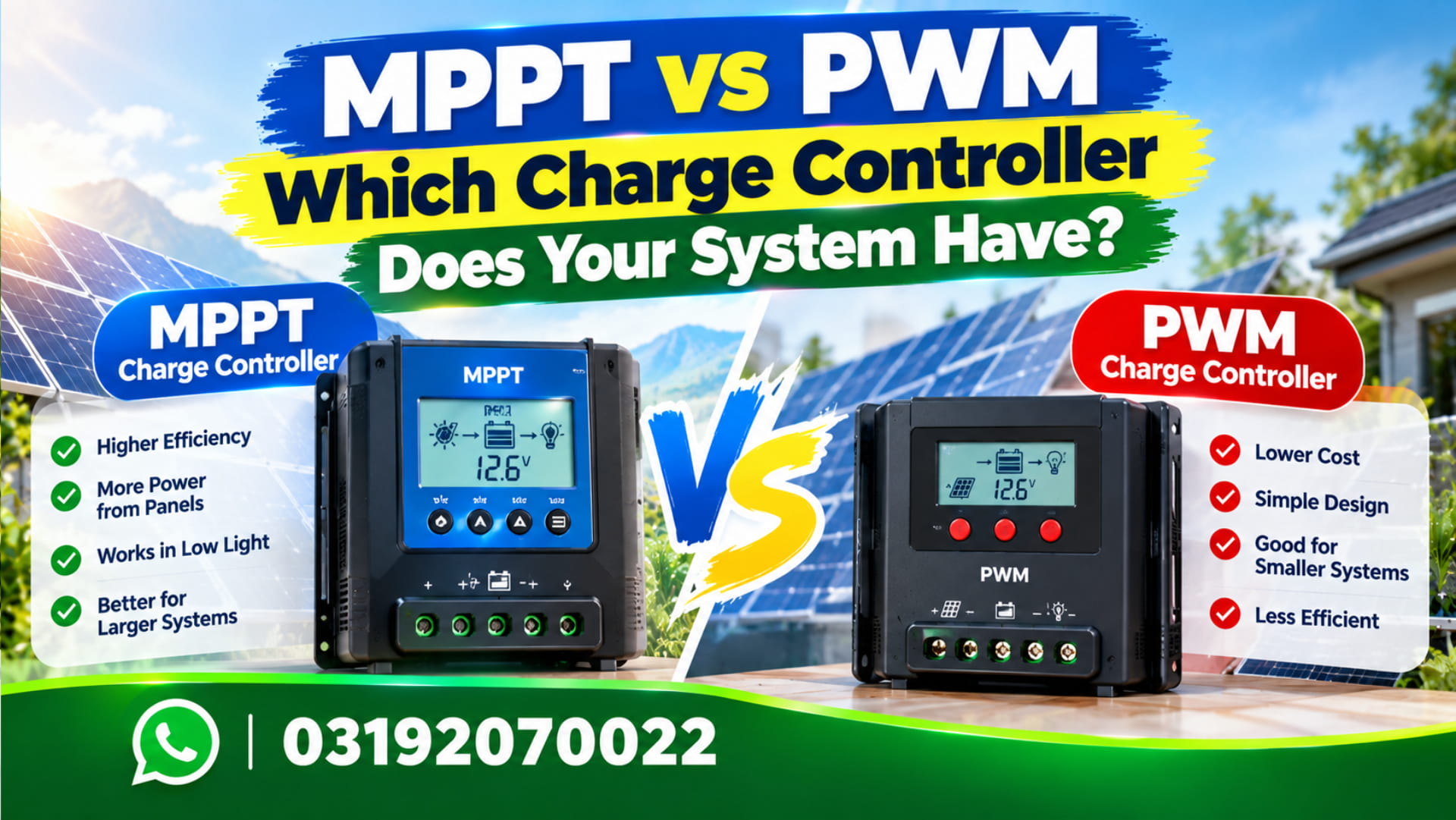
A charge controller sits between your solar panels and your battery, and which type it uses can be the difference between capturing nearly everything your panels produce and quietly losing a fifth or more of it as wasted heat. MPPT (Maximum Power Point Tracking) and PWM (Pulse Width Modulation) are the two technologies in use, and almost every modern hybrid or off-grid inverter sold in Pakistan today has MPPT built in. This matters most for standalone charge controllers used in smaller off-grid setups, where the choice is still explicitly yours.
This guide explains what each actually does, how large the efficiency gap really is, and how to check which one your own system uses.
What a charge controller actually does
A solar panel’s output voltage and current vary constantly with sunlight and temperature, while a battery needs a controlled, specific charging voltage to charge safely without being damaged by overcharging. A charge controller’s job is to manage that mismatch, and the two technologies do it in fundamentally different ways.
How PWM works
A PWM controller connects the panel directly to the battery and rapidly switches that connection on and off to control the charging rate as the battery approaches full charge. Critically, a PWM controller does not convert voltage, it simply clamps the panel’s output down to whatever the battery’s voltage happens to be at that moment. If your panel is rated to produce 20 volts but your battery sits at 13 volts, the difference between those two numbers is current you paid for and simply never get, wasted rather than converted into anything usable.
How MPPT works
An MPPT controller actively searches for the panel’s maximum power point, the voltage and current combination at which it is producing the most actual power at that moment, and then converts any voltage above what the battery needs into additional current instead of throwing it away. This is a genuine electronic conversion, similar in principle to a transformer, and it is why an MPPT controller can draw meaningfully more usable power from the exact same panels as a PWM controller would, with no change to the panels themselves.
How big is the efficiency gap, really
The gap depends entirely on how closely your panel’s voltage matches your battery’s voltage. If a 12V-rated panel is feeding a 12V battery almost directly, the two voltages are already close, and a PWM controller loses relatively little, often only a few percent. But most systems with panels wired in series to raise voltage for longer cable runs, or any system using 24V or 48V battery banks with panels producing considerably more, see PWM controllers waste 20 to 30 percent of the panels’ potential output as pure heat. MPPT captures 95 to 99 percent of what the same panels can produce under the same conditions, regardless of the voltage mismatch.
| Factor | PWM | MPPT |
|---|---|---|
| How it manages voltage mismatch | Clamps panel voltage down to battery voltage, wasting the difference | Converts excess voltage into extra current, capturing it |
| Typical efficiency when voltages are mismatched | 70 – 80% of potential output | 95 – 99% of potential output |
| Typical efficiency when voltages are already closely matched | Close to MPPT, little difference | Marginal gain over PWM |
| Relative cost | Lower | Higher, often by a meaningful margin |
| Suited to | Small, simple, closely-matched 12V systems | Any system with series-wired panels, higher battery voltages, or lithium batteries |
When PWM is genuinely fine
PWM is not a bad technology, it is simply limited to a narrower set of situations where it works almost as well as MPPT for considerably less money. A small single-panel system charging a single 12V lead-acid battery, such as a basic setup for a security light, a small DC fan, or a simple off-grid cabin with modest needs, is a reasonable place for PWM, since the voltage mismatch it struggles with barely exists in that configuration.
When MPPT is the right choice, not just the better one
Any system where panels are wired in series to raise voltage, which is standard practice on anything beyond the smallest setups, needs MPPT to avoid losing a meaningful share of output. Any system using a 24V or 48V battery bank with typical panel voltages well above that almost always needs MPPT for the same reason. Lithium batteries in particular benefit from MPPT’s precise, multi-stage charging profile, since a PWM controller’s cruder on-off switching is a poorer match for the tighter voltage tolerances lithium chemistry prefers. And any system sized above roughly a kilowatt of panels is large enough that the rupee value of the lost 20 to 30 percent quickly outweighs the price difference between the two controller types.
Does your system already have this built in?
For the vast majority of homes and businesses in Pakistan buying a complete hybrid or off-grid inverter package, this decision has effectively already been made for you. Nearly every modern hybrid inverter sold here includes an MPPT charge controller built into the unit itself, so if you have purchased a complete system through a standard quote, you almost certainly already have MPPT without having had to ask for it specifically. The differences between inverter categories, and what each one includes, is covered in our hybrid inverter price in Pakistan guide.
This question matters far more for a standalone charge controller bought separately, commonly used for off-grid applications like a solar water pump, a tubewell, a street light, or a small DC-only cabin system not built around a full hybrid inverter. In those setups, the charge controller is a distinct, separately specified component, and it is worth confirming which type you are actually buying.
How to check which one you have
Look at the charge controller’s label or nameplate directly, which almost always states MPPT or PWM clearly as part of the model name or specification. If you only have a manual or a receipt, search the model number, since manufacturers rarely omit this from their marketing given it is a genuine selling point. As a rough physical clue, if your system has multiple panels wired in series producing a combined voltage noticeably higher than your battery bank’s voltage and the system still charges efficiently, it is almost certainly MPPT, since a PWM controller in that configuration would show visibly poor charging performance that is hard to miss.
A worked example
A small off-grid setup for a shop uses two 585W panels wired in series, producing around 80 volts combined, charging a 24V lithium battery bank. With a PWM controller, the controller would clamp that 80 volts straight down to roughly 24 volts, discarding the bulk of the voltage difference and delivering well under half of what the panels are actually capable of in that configuration. Swapping to an MPPT controller converts that same voltage difference into additional current instead, commonly recovering 30 percent or more extra usable charging power from the identical two panels, with no other change to the system. The price difference between a PWM and MPPT controller of this size is typically recovered within the first one to two years purely from the extra output captured, after which the gain is pure saving for the rest of the system’s life.
Why MPPT matters even more in cooler weather
A solar panel’s output voltage actually rises as its temperature drops, which is the opposite of what most people expect. On a cold, clear winter morning, panel voltage can run noticeably higher than on a hot summer afternoon, which widens the exact gap between panel voltage and battery voltage that a PWM controller wastes and an MPPT controller captures. This means the efficiency advantage of MPPT is not a fixed number across the year, it tends to be largest precisely during the cooler months when every extra unit of charging matters more for a battery that is also recovering from shorter winter days.
Wiring choices MPPT opens up
Because an MPPT controller tolerates a wide difference between panel voltage and battery voltage, it also gives an installer more freedom in how panels are physically wired together. Panels can be connected in series to reduce the number of separate cable runs back to the controller, which lowers cabling cost and resistance losses over longer distances, something a PWM system cannot do without either accepting poor efficiency or adding extra parallel wiring to keep voltage low. For a larger roof or a controller mounted some distance from the array, this wiring flexibility is a real, practical advantage beyond the raw efficiency number, and it is one of the reasons installers default to MPPT on anything beyond the smallest systems.
What this means for your battery
A charge controller that charges inefficiently does not just waste potential output, it can also mean your battery spends more days partially charged than it should, which matters more for lithium, where consistent, correctly profiled charging supports a longer working life. Our lithium battery guide covers how capacity and charging behaviour interact, and if your battery seems slow to charge even on a sunny day, the solar panel not charging battery guide walks through the fuller charging-chain diagnosis, of which the controller is one link.
Getting it right at installation
A properly specified installation matches panel voltage, controller type and battery voltage deliberately, rather than defaulting to whatever is cheapest without checking the combination actually fits. This is one of the details that separates a system engineered correctly from one assembled from whatever components were available, which our solar panel installation in Karachi guide touches on more broadly.
Getting help through BuySolars
If you are speccing a standalone off-grid setup, such as a tubewell, street light or small cabin system, send us your panel count, wiring configuration and battery voltage, and we will confirm whether PWM is genuinely adequate or whether MPPT will pay for itself quickly. For a complete home or business hybrid system, MPPT is already part of a properly specified quote. We supply inverters, controllers and batteries with nationwide delivery, and current stock is on our products page.
WhatsApp 03192070022 to confirm the right charge controller for your setup.
MPPT is more efficient in almost every real-world configuration, especially where panel voltage exceeds battery voltage. PWM is only comparably efficient in small, closely voltage-matched setups.
No, nearly all modern hybrid inverters sold in Pakistan already include MPPT built in. This choice mainly applies to standalone off-grid controllers.
Commonly 20 to 30 percent when panel voltage is noticeably higher than battery voltage, though less if the two are already closely matched.
It benefits significantly from it, since MPPT’s precise multi-stage charging better matches lithium’s tighter charging tolerances than PWM’s simpler switching.
Check the label or model number on the controller itself, which almost always states MPPT or PWM directly.