
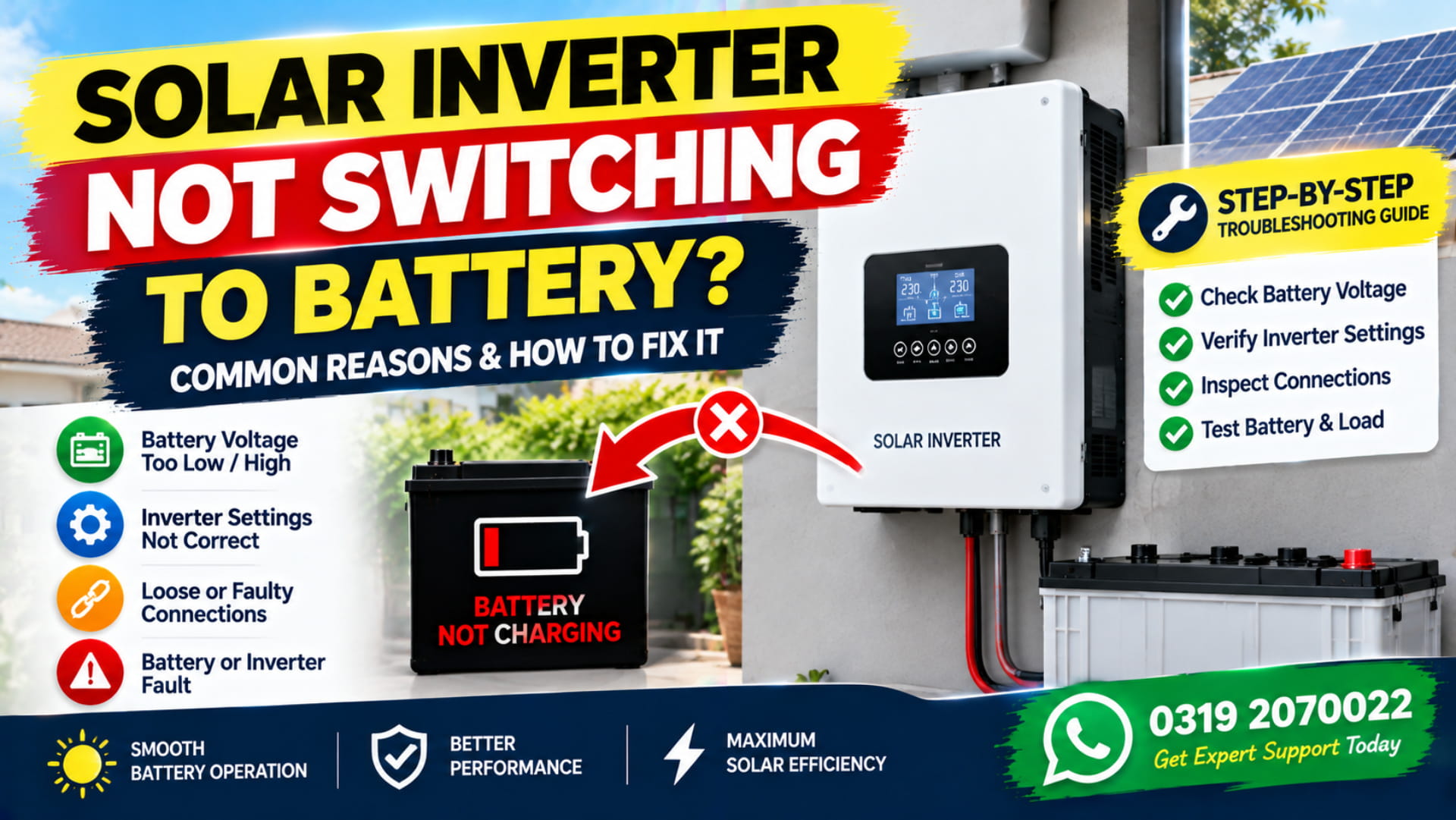
The grid goes out, the house goes dark, and the inverter does nothing even though there is a fully charged battery sitting next to it. This is one of the most frustrating faults in a solar system because everything looks healthy right up to the moment you actually need it.
Before troubleshooting, settle one question that resolves a large share of these cases: is your inverter actually capable of switching to battery at all? A plain on-grid inverter has no battery input and is designed by law to shut down when the grid fails. If that is what you own, nothing is broken and no setting will fix it. Only a hybrid or off-grid inverter can run from a battery.
If you do have a hybrid or off-grid unit with a battery connected, the causes below are listed roughly in the order they turn out to be the problem, from a setting in a menu through to a genuine hardware fault.
Settings menus, terminology and protection thresholds vary by brand and firmware, so check your own manual alongside this guide.
First, work out which symptom you actually have
These three look similar and point to different causes. Identify yours before you change anything.
| Symptom | What it suggests |
|---|---|
| Nothing happens at all, no sound, no output | Battery not reachable, wrong mode setting, or BMS has disconnected |
| Transfers, then shuts down within seconds | Overload, low battery voltage, or a sagging connection |
| Transfers, but with a gap long enough to reboot devices | Normal break-before-make transfer, not a fault |
That third row matters. Most hybrid inverters sold here use a changeover that takes a fraction of a second, long enough that a desktop computer or some LED drivers may blink or restart. Only a true online or double-conversion unit gives a seamless handover. A brief flicker at transfer is expected behaviour rather than something to repair.
Cause 1: It is an on-grid inverter, not a hybrid
The most common reason an inverter never switches to battery is that it was never built to. On-grid inverters must disconnect the moment grid supply is lost, because feeding power into a dead line would endanger utility staff working on it. There is no battery terminal, no battery menu, and no setting that changes this.
Check the nameplate and the manual for a battery voltage specification such as 48V. If there is none, you have an on-grid unit. The difference between on-grid, hybrid and off-grid equipment, and what each one can actually do during load shedding, is set out in our hybrid inverter price in Pakistan guide.
Some installations also pair an on-grid inverter with a separate battery inverter or a UPS. In that arrangement, the fault may be in the second device rather than the solar inverter you are looking at.
Cause 2: The battery breaker or fuse is open
Nearly every correct installation puts a breaker or fuse between the battery and the inverter. If it has tripped, or was switched off during maintenance and never switched back, the inverter sees no battery and has nothing to transfer to.
Look for a DC breaker near the battery bank, a fuse in a holder on the positive cable, or an isolator switch on a battery cabinet. Many lithium packs also have their own power switch or a circuit breaker on the unit itself. Check all of them. This is the cheapest fix on the list and it is overlooked constantly, particularly after any service visit.
If a breaker trips again immediately after you reset it, stop. That indicates a fault downstream, not a nuisance trip, and forcing it repeatedly risks damage.
Cause 3: The output source priority setting is wrong
Hybrid inverters let you choose where load power comes from first. The menu name varies, commonly appearing as output source priority, output mode, or on some models a three-way choice between utility first, solar first and solar-battery-utility.
If the unit is set to take utility as the priority source and only use the battery when the grid is absent, transfer should happen automatically. But installers sometimes set a configuration that keeps the battery in reserve, or a setting gets changed during commissioning and never reviewed. Open the menu and confirm that battery discharge to the load is actually permitted.
Check the charger source priority too. A configuration that only charges from the grid, combined with low solar generation, can leave a battery that never reaches a usable state of charge in the first place.
Write down the current settings before you change anything, so you can restore them if the change does not help.
Cause 4: The battery type or voltage thresholds are set wrong
This one causes a great deal of confusion. A hybrid inverter needs to be told what kind of battery is connected, because the voltage thresholds for a lead-acid bank and a lithium bank are different.
If a lithium battery is installed but the inverter is still configured for lead-acid, or the low-voltage cutoff is set too high, the inverter may read a healthy battery as nearly empty and refuse to discharge it. The battery looks fine, the display may even show a reasonable voltage, and yet transfer never happens because the unit believes it is protecting a flat battery.
Confirm three things in the menu: the battery type, the low-voltage disconnect or cutoff setting, and the back-to-grid or recovery threshold. These should match the battery manufacturer’s recommended values, which are in the battery’s own documentation. How capacity, usable depth of discharge and voltage behaviour differ between chemistries is covered in our lithium battery guide.
Battery pricing changes with the market, so WhatsApp us now for the latest price of the battery at 03192070022 if the diagnosis points to a replacement.
Cause 5: The BMS has locked out discharge
Every lithium battery has a battery management system that can refuse to discharge, independently of whatever the inverter wants. It will do this to protect the cells after a deep discharge, during over-temperature or under-temperature conditions, on detecting cell imbalance, or following an over-current event.
From outside, a BMS lockout looks exactly like a dead battery. The inverter reports no available battery and will not transfer. Many packs show this on their own indicator lights or app rather than on the inverter screen, so check the battery itself, not just the inverter.
Some lockouts clear after a full disconnect and reconnect cycle. Others require the underlying condition to be corrected first, and a deeply discharged lithium pack in particular should be recovered by a qualified technician rather than coaxed back with improvised charging. Never bypass a BMS protection to force discharge.
A related trap: some lithium batteries ship in a sleep or storage mode and need activating with a button press or an initial charge before they will operate at all. A brand new battery that has never worked may simply never have been woken up.
Cause 6: Communication between inverter and battery has failed
Many hybrid inverters paired with lithium batteries talk to the BMS over a CAN bus or RS-485 link, so the inverter can read the real state of charge rather than guessing from voltage. If that cable is loose, damaged, wired to the wrong port, or the battery protocol was never matched correctly to the inverter model, the inverter may refuse to discharge rather than operate blind.
Check the communication cable at both ends, confirm it is in the correct port, and confirm the battery protocol selected in the inverter menu matches the battery brand. Fault codes that accompany communication and voltage problems, and how to read them, are covered in our inverter F01, F07, F22 error code guide.
Cause 7: It transfers but trips straight back out
If the inverter does switch over and then shuts down within a second or two, the problem is not the transfer at all. It is what happens immediately afterwards.
The usual culprit is load. An inverter’s capacity in battery mode has to cover everything connected at that instant, including the start-up surge of any motor or compressor that happens to kick in during the changeover. During load shedding every appliance that was running on the grid lands on the inverter simultaneously, which is a far harsher test than normal operation. This is the same mechanism explained in our inverter overload problem solution guide.
Test it deliberately. Turn off the air conditioner, the iron and any pump, then cut the main supply and watch what happens. If transfer now succeeds and holds, you have found an overload rather than a transfer fault.
Two other possibilities produce the same symptom. A battery that is genuinely near its cutoff will transfer and then disconnect on low voltage within moments. And loose, corroded or undersized battery cabling can cause voltage to sag the instant load is applied, which the inverter reads as a flat battery even though it is not. Check terminal tightness and cable gauge.
Cause 8: The grid has not actually failed as far as the inverter is concerned
Occasionally the inverter is right not to transfer. If voltage is low but present, or supply is fluctuating rather than absent, the unit may still see utility power as available and stay on it. In that situation the lights dim and appliances struggle but the inverter never changes over.
Most hybrid inverters have configurable input voltage limits that determine when utility power is considered unacceptable. If brownouts are common in your area, these thresholds are worth reviewing with your installer rather than adjusting blind, since setting them too tight makes the system transfer unnecessarily and drain the battery during minor dips.
Also check whether a manual bypass or maintenance switch has been left in the grid position. Some installations include one, and it does exactly what it is designed to do: keep the load on utility power and bypass the inverter entirely.
Cause 9: The transfer relay or an internal component has failed
If the battery is reachable and healthy, the settings are correct, the BMS is not objecting, communication is intact, and the load is modest, the remaining explanation is a hardware fault inside the inverter, most often the transfer relay that physically switches the output between sources.
This is not a self-repair job. Note the model, any fault code shown and exactly what you have already ruled out, then arrange a technician or a warranty claim. Opening the casing yourself can void the warranty even where the eventual repair is trivial.
A diagnostic order that saves time
Work through these in sequence rather than changing several things at once.
- Confirm the inverter type. Hybrid or off-grid with a battery terminal, or plain on-grid? If on-grid, stop here.
- Check every battery breaker, fuse, isolator and the battery’s own switch.
- Read the battery voltage and state of charge, both on the inverter display and on the battery’s own indicator or app.
- Check the output source priority and charger priority settings, writing down what they were first.
- Check the battery type and the low-voltage cutoff setting against the battery manufacturer’s figures.
- Check the communication cable and protocol selection if you have a lithium battery.
- Reduce the load to a minimum and test the transfer deliberately by switching off the main supply.
- Inspect the battery terminals and cable for looseness, discolouration or corrosion.
- If all of the above are clear, call a technician and report what you have already eliminated.
Stop immediately and switch the system off at the isolator if you smell burning, see scorch marks, or a breaker trips repeatedly on reset.
Preventing it from happening again
Test the transfer monthly. Switch off the main supply deliberately for a minute and confirm the system carries the load. A backup system that is never tested is a backup system you do not actually know you have.
Record your settings. Photograph the inverter’s configuration screens after commissioning. If a setting drifts or someone changes it, you have a reference.
Size the battery-mode capacity honestly. Decide which circuits must survive an outage and make sure the inverter and battery can carry that set, including surges, rather than the whole house.
Keep the connections tight. Battery terminals and DC connectors should be part of an annual check, more often in coastal Karachi where corrosion is faster.
Do not run the battery flat repeatedly. Deep discharges are the most common route to a BMS lockout.
Getting help through BuySolars
Send us the inverter brand and model, the battery type, any fault code on the display, and which of the checks above you have already done. That combination usually identifies the cause within a few messages rather than a site visit. We supply hybrid inverters and documented batteries with nationwide delivery, and current stock is on our products page.
WhatsApp 03192070022 with your inverter model and fault code for a quick diagnosis.
Most often because it is an on-grid unit with no battery capability, a battery breaker is open, or a menu setting blocks discharge.
No. It has no battery input. You would need a hybrid inverter or a separate battery inverter.
Usually overload at the moment of transfer, a battery near its cutoff, or loose and undersized battery cabling.
Commonly a wrong battery type setting, a cutoff set too high, or failed communication with the battery’s BMS.
Yes. Most hybrid inverters take a fraction of a second to change over, which can restart sensitive devices.