
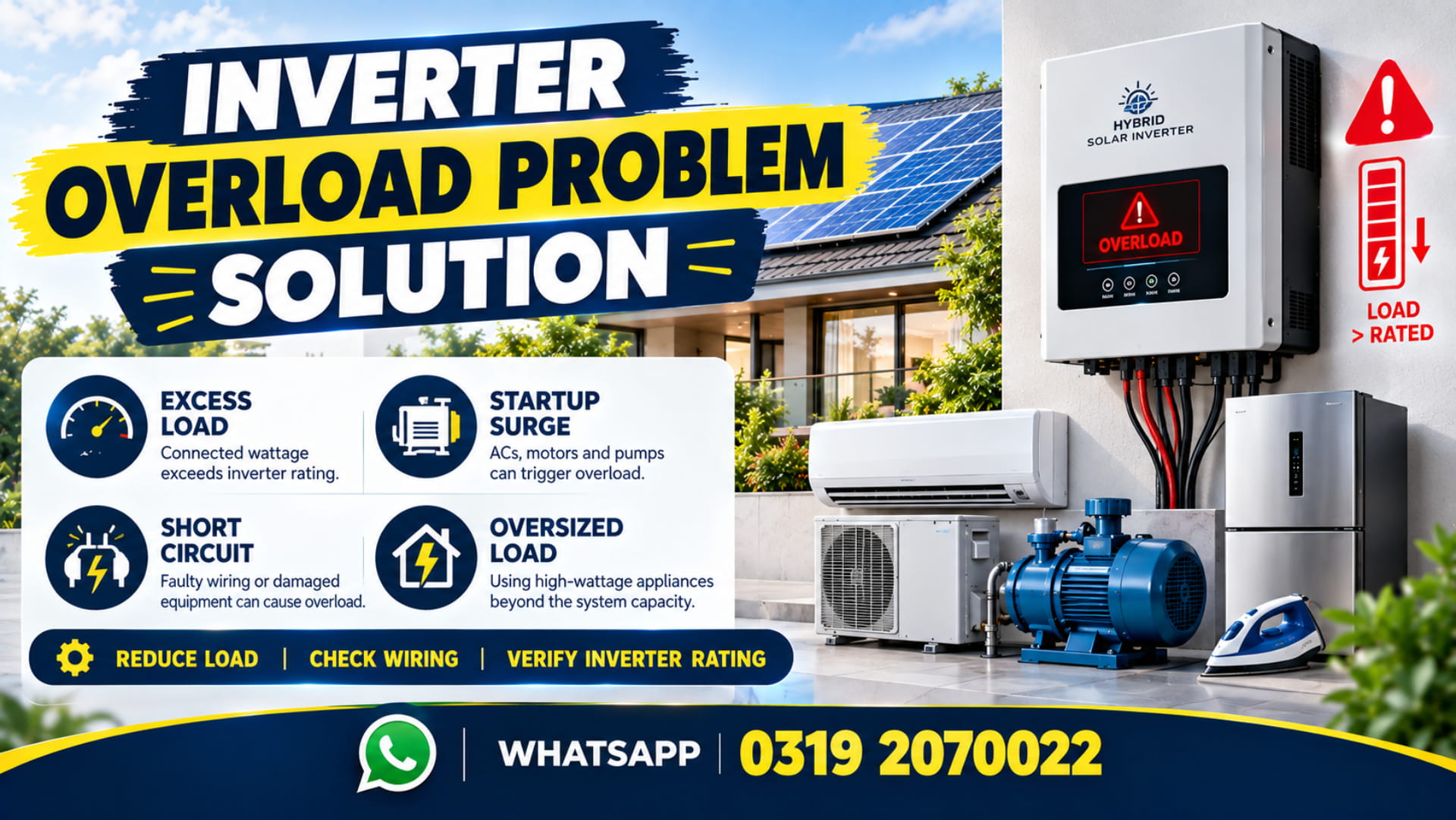
An inverter that keeps overloading is not a mystery fault, it is almost always a straightforward mismatch between what you are asking it to supply and what it is actually rated to deliver. The good news is that once you understand the two different ways overload actually happens, the fix is usually a few practical changes rather than an expensive replacement, though sometimes replacement genuinely is the honest answer.
If you landed here after seeing an overload beep or an F07 overload time out code, this guide is the deeper dive on fixing the cause permanently rather than just clearing the alarm each time it trips.
Two different kinds of overload, and why the distinction matters
Sustained overload is the simple case: the total running load connected at once genuinely exceeds the inverter’s continuous rated output, and it will keep tripping every time that combination of appliances runs together, regardless of how many times you reset it.
Surge overload is sneakier. Your running load might sit comfortably within the inverter’s rated capacity, yet the inverter still trips the moment a motor-driven appliance starts, because starting a compressor or motor draws two to three times its normal running current for a second or two before settling down. An inverter sized only against running totals, without headroom for this surge, will overload every time that appliance switches on, even though the connected load looks fine on paper.
Telling these two apart changes what you fix. Sustained overload needs less load connected at once. Surge overload needs either more surge headroom in the inverter or a way to soften the startup spike itself.
How to calculate your actual load, properly
Most overload problems trace back to never having done this calculation honestly in the first place. Here is the approach that actually catches the surge problem rather than just adding up running wattages.
| Appliance | Typical running load | Typical startup surge |
|---|---|---|
| 1 ton inverter AC | 900 – 1,200W | 1.5 – 2x running |
| 1 ton non-inverter AC | 1,200 – 1,500W | 2.5 – 3x running |
| Water motor / pump (0.5–1 HP) | 370 – 750W | 2.5 – 3.5x running |
| Refrigerator | 150 – 300W | 2 – 3x running |
| Iron | 1,000 – 1,800W | negligible, resistive load |
| Washing machine (motor-driven) | 300 – 500W | 2 – 3x running |
| LED lights, fans, TV, router | 200 – 400W combined | negligible |
List every appliance you expect to run on backup, add up the running totals for your worst realistic combination, then separately check the single largest surge in that combination added on top of everything else already running. That second number, not the running total alone, is what actually trips a surge-related overload, and it is the number most quotes and most DIY sizing skip entirely.
A worked example makes this concrete. A household running a refrigerator, lights and fans continuously, roughly 500W, then starting a 1 ton inverter AC on top, adds another 900 to 1,200W running plus a surge spike of up to 2,400W for a second or two. An inverter rated at 3kW continuous with only modest surge headroom can handle the running total comfortably and still trip the instant that AC compressor kicks in, because the real test is the surge moment, not the settled-in running figure.
Why this keeps happening specifically during loadshedding
A pattern specific to Pakistani households makes this worse than it needs to be. During a power cut, everything that was running on grid switches to inverter power at effectively the same moment, the AC that was already on, the refrigerator cycling, the motor if it happens to kick in, all simultaneously drawing from a system that may never have been asked to start all of them together before. On grid power this never shows up as a problem because the grid has effectively unlimited surge capacity. An inverter does not, and loadshedding is exactly when that gap gets exposed.
Immediate fixes, while you are mid-overload
Turn off or unplug the heaviest appliance you can live without for a few minutes, usually the AC or the iron, and let the inverter’s alarm clear before restarting. Stagger what switches back on rather than turning everything on at once; start the AC first, let its surge settle, then bring other appliances online one at a time rather than simultaneously. If the fault clears and does not return under a lighter combination, you have confirmed the cause is sustained or surge overload rather than a hardware fault, and the permanent fixes below are what actually stop it from recurring.
The permanent fixes, in order of cost
Right-size the inverter against surge, not just running load. This is the fix that should have happened at installation and the one most quotes skip. When evaluating or upgrading an inverter, check both its continuous rating and its documented surge-handling capacity, and size against your worst realistic combination including the largest single surge on top of everything else already running, not just the sum of running wattages. Getting this right from the start, matched to your actual appliance list rather than a generic package, is covered in our hybrid inverter price in Pakistan guide, and the AC-specific version of this sizing problem, since air conditioning is the single most common surge culprit in Pakistani homes, is worked through in detail in our solar panels for 1 ton AC guide.
Separate critical and non-critical circuits. Rather than backing up the entire house on one inverter, wire essential loads, lights, fans, refrigerator, router, onto a dedicated backup circuit, and leave heavier intermittent loads like AC, iron, and washing machine on a separate switchable circuit. This means a loadshedding moment no longer forces every appliance to restart simultaneously on limited inverter capacity, since the heavy ones are not on the automatic backup path at all unless you deliberately bring them on. Correct circuit separation is a wiring decision made at installation time, covered in our solar panel installation in Karachi guide, and the same approach applies anywhere in the country.
Add soft-start capability for motor-driven appliances. A soft starter on an AC compressor or water motor smooths the current draw at startup instead of letting it spike instantly, which can meaningfully reduce the surge an inverter has to absorb in that first second. This is a relatively low-cost add-on compared with a full inverter upgrade and is worth discussing with your installer if surge overload is your specific, recurring trigger.
Upgrade the inverter’s capacity. If your real, honestly calculated load, including surge, genuinely exceeds what your current inverter can deliver even after staggering and circuit separation, the fix is a larger-capacity unit rather than continuing to work around an undersized one. This is also the point to confirm your battery bank is sized to actually support the larger inverter’s draw, covered in our solar ke liye kitni battery chahiye guide, since an inverter upgrade without a matching battery upgrade just moves the bottleneck rather than removing it.
Reading the fault correctly before you fix anything
Before assuming overload is the cause, confirm it actually is. An overload trip typically shows a specific overload or overload-time-out indication on the inverter’s display rather than a generic shutdown, and the exact code and what it means, including the F07 overload time out code common on Voltronic-style firmware used by many Pakistani-market inverters, is covered in our inverter F01, F07, F22 error code guide. If the inverter is beeping rather than showing a clear overload code, it is worth ruling out the other common alarm causes first, since not every beep is an overload, a distinction covered in our inverter beeping sound guide.
A quick test you can run yourself
Most inverters with an LCD or companion app show a live load percentage figure, how much of rated capacity is currently being drawn. Use this to find your real headroom without guessing. With only lights and fans running, note the percentage shown. Add the refrigerator and note it again. Then switch on the AC or motor and watch the percentage at the exact instant it starts, not a few seconds later once it has settled, since that instant is where the surge actually shows up. If the reading spikes close to or past 100 percent right at startup even though it settles lower afterward, you have just confirmed a surge-related overload rather than a sustained one, and you now know which of the fixes above actually applies to your situation rather than guessing between them.
When it is not actually overload
Occasionally what looks like a recurring overload is something else wearing the same symptom: a weak or aging battery that cannot deliver enough current even for a load the inverter itself could otherwise handle, a loose DC connection causing voltage to sag under load, or a genuine inverter fault unrelated to load at all. If you have correctly calculated your load, confirmed it is within both the continuous and surge ratings of your inverter, and the trips continue regardless, treat it as a separate fault rather than continuing to reduce load that was never actually the problem.
Getting it right through BuySolars
If you are not confident in your own load calculation, send us your full appliance list, including anything motor-driven, over WhatsApp, and we will help you work out the real running and surge totals before recommending a specific inverter size. This is worth doing before buying rather than after, since undersizing against surge is the single most common reason people end up back on this exact problem within months of a new installation.
We stock hybrid and on-grid inverters across a range of capacities with nationwide delivery. Current stock is on our products page.
WhatsApp 03192070022 with your appliance list for a correctly sized inverter recommendation.