
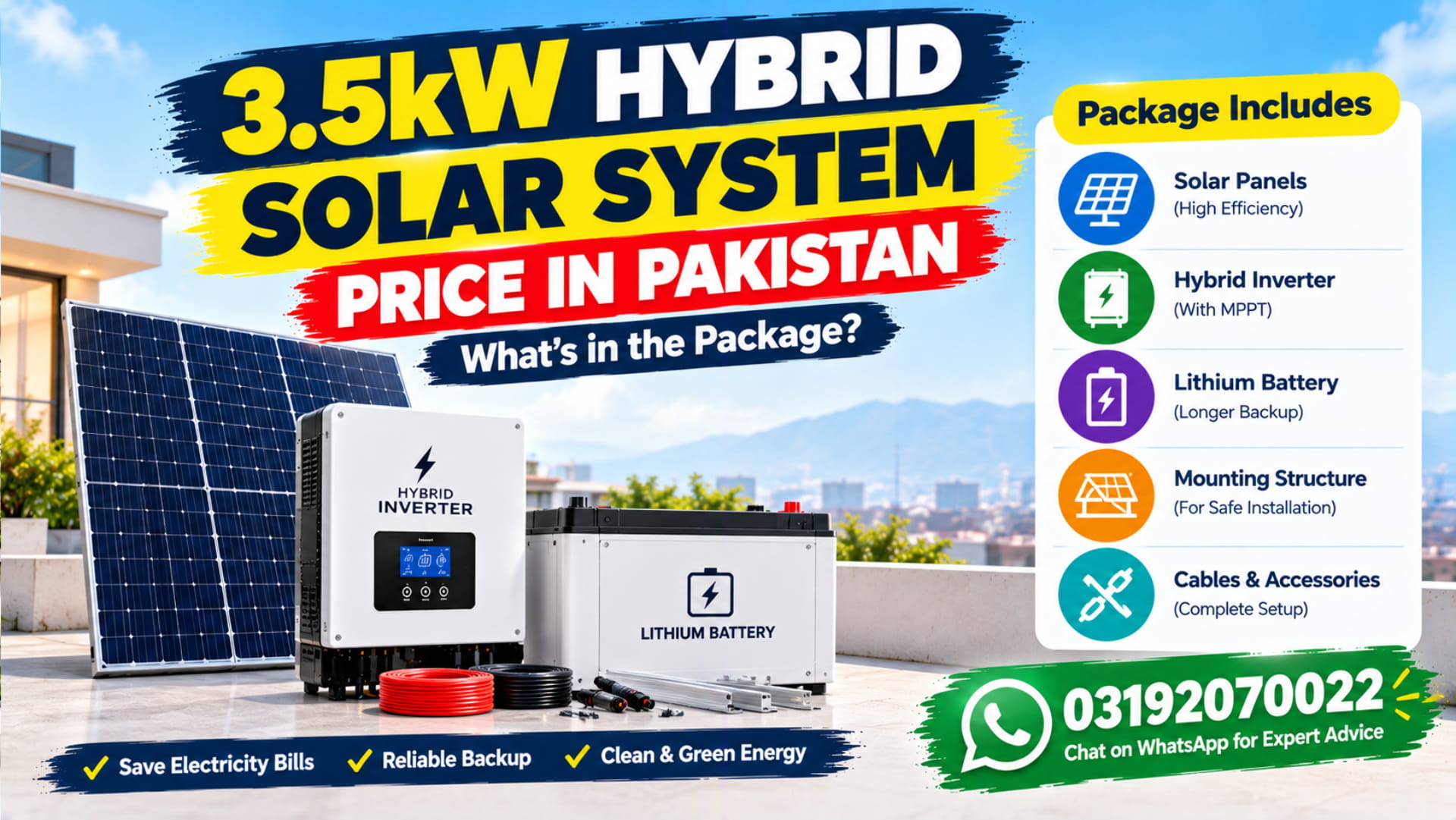
A 3.5kW hybrid solar system is the size most small Karachi homes, apartments, and single-family bungalows land on when they want backup power without paying for capacity they’ll never use. It is big enough to carry a modest household through load shedding, and small enough that the price stays within reach of a one-time budget rather than a loan.
The installed price for a 3.5kW hybrid system in Pakistan typically runs Rs 480,000 to Rs 650,000, not counting the lithium battery, whose price changes too often to quote reliably here — WhatsApp us now for the latest price of the battery at 03192070022. Add the battery and the total package usually lands somewhere between Rs 650,000 and Rs 950,000+, depending on the battery’s capacity and chemistry.
That’s the headline number. The more useful question — and the one most buyers never get a straight answer to — is what that money actually buys. This guide breaks the 3.5kW hybrid package into its component parts, so you know exactly what should be on your invoice before you pay a deposit.
Who a 3.5kW Hybrid System Actually Fits
A 3.5kW hybrid system suits a household that:
- Pays a monthly electricity bill in the Rs 12,000 to Rs 28,000 range
- Runs fans, lights, a refrigerator, a Wi-Fi router, a washing machine, and maybe one inverter-type air conditioner on light duty
- Lives in a small house, upper-portion flat, or apartment with limited roof or balcony space
- Wants backup during load shedding more than it wants to zero out a large bill
If your bill regularly exceeds Rs 35,000 a month, or you’re running two or more ACs through peak summer, a 3.5kW system will leave you short. At that point it’s worth comparing against a 5kW solar system, which carries meaningfully more daytime load and a bigger battery bank. For a single room or a very light load — one AC, one fridge, lighting — a 1kW system might actually be the better fit, and cheaper than oversizing to 3.5kW.
The Itemized Breakdown: What’s in a 3.5kW Hybrid Package
This is the part most price lists skip. A 3.5kW hybrid system isn’t one product — it’s six or seven components bundled together, each with its own cost range. Here’s what a proper quote should itemize:
| Component | Specification | Approximate Cost (PKR) |
|---|---|---|
| Solar panels | 6 x 585W Tier-1 N-type (≈3.51kW), or equivalent | 155,000–170,000 |
| Hybrid inverter | 3.5kW–5kW rated, 24V or 48V platform, MPPT built-in | 150,000–230,000 |
| Lithium battery | 24V or 48V platform, typically 50Ah–100Ah to start | WhatsApp for current price |
| Mounting structure | Galvanized angle iron or aluminum rail, roof or ground mount | 25,000–35,000 |
| Cabling, breakers, surge protection, earthing | DC/AC cable, isolators, SPD, earthing rod | 30,000–45,000 |
| Net billing meter and DISCO paperwork | Bi-directional meter, application processing | 20,000–30,000 |
| Installation and commissioning | Labor, site visit, testing, handover | 40,000–55,000 |
| Subtotal (excluding battery) | 420,000–565,000 |
Add installer margin and transport, and most legitimate quotes for the panel-plus-inverter-plus-balance-of-system package (everything except the battery) land in the Rs 480,000–650,000 range quoted above. The battery is deliberately left out of that number because lithium prices move with the exchange rate and global cell supply far more often than panel or inverter prices do — which is exactly why we tell people to confirm it fresh over WhatsApp rather than trust a number printed months ago.
Why Panels Aren’t the Biggest Line Item Anymore
A few years ago, panels were the dominant cost in any solar quote. That’s flipped. At today’s Tier-1 panel pricing of roughly Rs 44–48 per watt, 3.51kW of panels costs around Rs 155,000–170,000 — now typically less than the hybrid inverter alone, and often less than the balance-of-system items combined.
This matters for two reasons. First, it means cutting corners on panels to save money barely moves the total price anymore, so there’s little financial reason to accept B-grade or mismatched cells — see A-grade vs B-grade solar panels for what the difference actually costs you in output over time. Second, it means the inverter and battery are where quotes genuinely diverge between installers, so that’s where you should spend your comparison time.
Why Hybrid Instead of On-Grid at This Size
A pure on-grid 3.5kW system (no battery, feeds excess to the grid, shuts off when the grid is down) typically prices Rs 50,000–90,000 cheaper than the hybrid version, because you drop the battery-charging circuitry and backup logic from the inverter.
For a small household, that saving usually isn’t worth it. The whole reason most Pakistani homes install solar at 3.5kW rather than something larger is to protect against load shedding on a budget — and an on-grid-only system does nothing when the grid goes down, regardless of how sunny it is outside. If backup during outages matters to you at all, the hybrid premium is one of the better-value upgrades in the entire system, because it’s the one component that changes what happens the moment the lights go out.
If budget is genuinely tight, a reasonable middle path is to buy the hybrid inverter now (so the wiring and capability exist) and add the battery in a second purchase once funds allow — most 24V and 48V hybrid inverters are designed for exactly this staged approach. For a deeper look at how inverter specs and brands affect price at every system size, see hybrid inverter price in Pakistan.
How Much Power a 3.5kW System Actually Produces
Panel wattage is a rating under lab conditions, not a guarantee. Real output depends on Pakistan’s seasonal sun hours. Using Karachi’s typical peak sun hour bands:
| Season | Peak sun hours/day | Approximate daily output (3.5kW array) |
|---|---|---|
| Summer | 6–7.5 hrs | 17.5–22 units |
| Monsoon | 4–5.5 hrs | 12–16 units |
| Autumn | 5–6 hrs | 14.5–17.5 units |
| Winter | 4–5 hrs | 11.5–14.5 units |
On average, a 1kW array produces roughly 4–5 units a day in Pakistan, so a 3.51kW array lands around 14–17.5 units/day across the year — enough to meaningfully offset a bill in the Rs 15,000–25,000 range, though not to eliminate it entirely during winter, when both sun hours and panel output drop together. Dust accumulation can knock a further 5–15% off these numbers between cleanings, which matters more in Karachi’s coastal dust-and-salt environment than in cleaner inland areas.
What a 3.5kW Battery Can Actually Run
Buyers often assume a small system means a small, useless battery. In practice, a correctly sized battery on a 3.5kW hybrid system can comfortably carry:
- All lighting and fans in the house
- A refrigerator
- Wi-Fi router and a few phone/laptop chargers
- A washing machine run during the day on solar, or briefly on battery
- One inverter-type AC, for a limited number of hours, if the battery capacity is sized for it
What it typically cannot do is run a full-size AC continuously through a hot summer night on battery alone — that needs either a larger battery bank or a bigger system altogether. Be explicit with your installer about which loads need to survive an outage, in what order of priority, and for how long; that list is what actually determines battery sizing, not the inverter’s kW rating. Since lithium prices shift often, get the exact figure for your required capacity directly: WhatsApp us now for the latest price of the battery at 03192070022.
3.5kW On-Grid vs Hybrid vs Stepping Up to 5kW
| 3.5kW On-Grid | 3.5kW Hybrid | 5kW Hybrid | |
|---|---|---|---|
| Installed cost (excl. battery) | ~430,000–540,000 | ~480,000–650,000 | ~620,000–820,000 |
| Backup during load shedding | None | Yes, battery-dependent | Yes, battery-dependent |
| Daily output | 14–17.5 units | 14–17.5 units | 20–25 units |
| Best for | Grid-stable areas, lowest budget | Small homes wanting backup | Larger homes, 1–2 ACs |
If your bill sits near the top of the 3.5kW range (above Rs 25,000/month) and you expect your load to grow — a second AC, a new appliance, a room addition — it’s often cheaper in the long run to size up to 5kW now than to retrofit later. Retrofitting an existing array means matching old and new panel batches, which rarely performs as well as a single matched array from day one.
What Changes the Price Up or Down
Several specific factors move a 3.5kW hybrid quote by tens of thousands of rupees in either direction:
Panel brand and grade. Tier-1 N-type panels from established manufacturers price higher per watt than unbranded or B-grade stock, but degrade slower and carry real warranties. The 585W panel and similar high-wattage Tier-1 modules reduce the panel count needed, which can lower mounting and cabling costs too.
Inverter platform (24V vs 48V). 24V hybrid inverters are generally cheaper and suit smaller battery banks; 48V platforms cost more upfront but scale better if you plan to add battery capacity later.
Mounting type. Ground-mount structures on open plots cost more in steel than simple pitched-roof mounts, but may be unavoidable on flat RCC roofs without a suitable angle.
Cable run length. A roof-to-inverter distance beyond the typical 15–20 meters adds real cost in cable gauge and conduit, especially for larger homes with the inverter located far from the array.
DISCO and net billing delays. Since net billing replaced net metering on 9 February 2026, DISCO processing times and paperwork requirements vary by area; some installers price this as a fixed fee, others bill it separately if delays require repeat site visits.
Installer margin and warranty terms. A noticeably cheaper quote almost always means a shorter warranty, a smaller margin that disappears if something goes wrong post-installation, or a substitution of components from what was verbally promised.
Red Flags in a Cheap 3.5kW Quote
- No itemized breakdown — just one lump-sum number
- Panel wattage or brand left unspecified (“Tier-1 panels” with no datasheet)
- Battery platform voltage not stated, making future expansion guesswork
- No mention of earthing or surge protection as separate line items
- Installation and commissioning bundled into “free” with no labor cost shown
- No written warranty terms for inverter or panels
If a quote is quiet on more than one of these, ask directly before signing anything. For what to do if an installer later becomes unresponsive after taking a deposit, see what to do if your solar installer stops responding.
A Worked Example
Consider a small house in Karachi with a monthly electricity bill averaging Rs 18,000, running fans, lights, a fridge, a washing machine, and occasional use of one inverter AC in a single bedroom.
- Panels: 6 x 585W = 3.51kW, Rs 165,000
- Hybrid inverter (3.5kW–5kW rated, 48V): Rs 190,000
- Mounting, cabling, protection, earthing: Rs 65,000
- Net billing meter and paperwork: Rs 25,000
- Installation and commissioning: Rs 45,000
- Subtotal (excl. battery): Rs 490,000
- Lithium battery (48V, sized for essential night loads): price confirmed via WhatsApp
At an average of roughly 15.5 units/day across the year, this system offsets a large share of an 18,000-rupee monthly bill — self-consumed units valued at the full slab tariff (Rs 40–60/unit) and any exported surplus at the lower net-billing export rate (Rs 8–11/unit). Most households at this bill level and system size see payback in the 3 to 4.5-year range on the panel-and-inverter portion of the investment, with the battery adding to the upfront cost but paying for itself mainly through outage avoidance rather than bill savings alone.
Financing a 3.5kW System
A package in the Rs 650,000–950,000 total range (with battery) is a meaningful one-time cost for most households, but it isn’t the only path. Bank solar financing and leasing products have become more common since 2026, and a simple EMI comparison can clarify whether financing costs less over time than delaying the purchase while bills keep rising. See our solar loan EMI calculator guide to run the numbers for your own bill and budget before deciding.
Costs That Continue After Installation
A 3.5kW hybrid system is not a one-time purchase with zero ongoing cost. Expect:
- Panel cleaning, roughly monthly in dusty or coastal conditions, to recover the 5–15% output lost to dust
- Inverter lifespan of 8–12 years before replacement or major servicing
- Battery lifespan of 12–18 years for lithium, though usable capacity tapers gradually with cycle count
- Panel degradation of roughly 0.4–0.55% per year for N-type modules after the first year, meaning output in year 10 is still well above 90% of day-one rating
None of these should come as a surprise if your installer explained them upfront — and if your warranty paperwork doesn’t cover them clearly, it’s worth reviewing our guide on the solar panel warranty claim process in Pakistan before you need to use it.
Getting a Quote Through BuySolars
We quote 3.5kW hybrid packages with every component listed separately — panel brand and wattage, inverter model and platform voltage, mounting type, and installation scope — so you can see exactly where your money goes before committing. Battery pricing is confirmed at the time of your enquiry rather than published as a fixed number, since lithium cell costs move with global supply more than any other component in the system.
Browse full specifications and current panel and inverter options on our products page, or message us directly for a sizing recommendation based on your actual monthly bill: WhatsApp us now at 03192070022.
Roughly Rs 480,000–650,000 installed, excluding the battery; WhatsApp us at 03192070022 for the current battery price to get the full package total.
About six 585W panels, or five to six panels depending on the exact wattage used, totaling roughly 3.5kW.
It can usually run one inverter-type AC for a limited time on battery, but not a full-size AC continuously overnight — battery capacity, not the inverter’s kW rating, is the limiting factor.
It’s on the smaller side for that bill level; a 5kW system is usually a better match if your bill regularly exceeds Rs 25,000–28,000.
Lithium battery costs change frequently with exchange rates and global supply, so we confirm the current price directly over WhatsApp rather than publish a number that may already be outdated.