
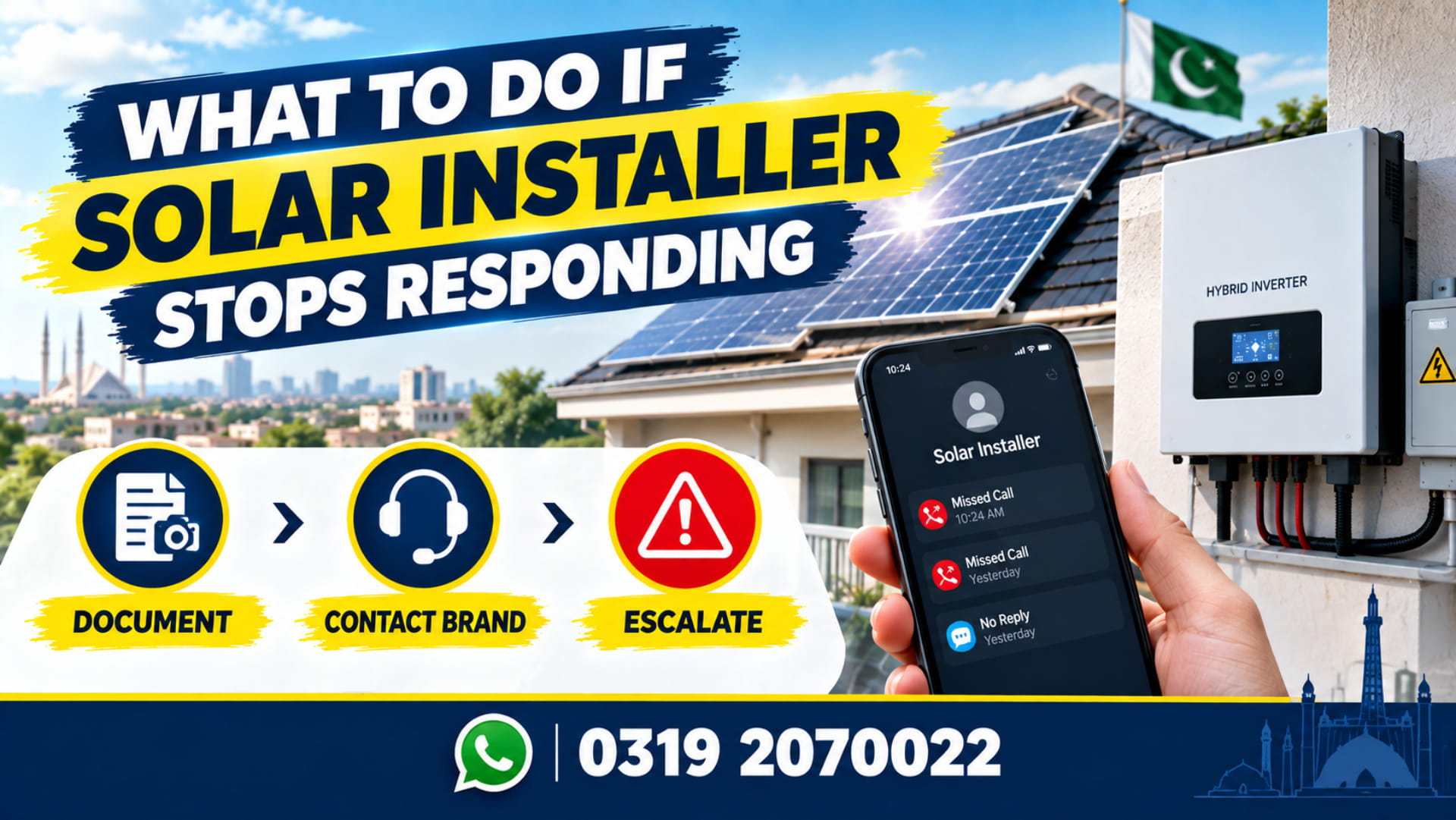
An installer who vanishes after the money has changed hands is one of the most common complaints in Pakistan’s solar market, and it usually falls into one of two situations. Either the system is finished but something is wrong with it and nobody answers your calls, or the job itself is half done and the crew has stopped coming. The steps differ slightly between the two, but the first move is the same: stop calling, start documenting.
This guide covers what to gather, how to write a notice that carries weight, how to keep the system safe and running in the meantime, how to bring in a second technician without wrecking your warranty, and what to do about the paperwork that only the original installer can complete. It is general guidance, not legal advice, and a lawyer or your provincial consumer protection office can tell you what applies to your specific contract.
First, work out which situation you are in
The system is installed and running, but a fault or a promised service is outstanding. Examples: the inverter shows an error, output has dropped, a loose cable was never fixed, or the installer promised to file the net billing application and has gone quiet. Your system may be producing power, which gives you time and some leverage.
The installation is incomplete. The structure is half built, panels are on the roof but not wired, the inverter is not commissioned, or material you paid for has not arrived. This is more urgent, because exposed wiring and loose panels are a safety and weather risk, and because every week of delay weakens your position.
Be honest about which category you are in. It decides whether your priority is making the system safe or getting a fault repaired.
Step 1: Build your evidence folder before you escalate
Pull together everything in one place, paper and phone, before sending a single angry message.
- The quotation and any written agreement, including what was promised on timelines, equipment and after-sales support.
- Proof of every payment: bank transfer receipts, cheque stubs, or messages confirming cash received. Cash with no receipt is the weakest position, so write to the installer now asking them to confirm the amounts received.
- The invoice or delivery notes for panels, inverter and battery, showing brand, model and quantity.
- Photographs of the installation as it stands today, from several angles, with the date visible. Photograph panel serial numbers, the inverter nameplate and any fault code on the display.
- Your whole message history with the installer, screenshotted. Include the unanswered ones, because a run of ignored messages with dates is itself evidence.
If you paid for equipment, check that what is on the roof matches what is on the invoice. A substituted brand or a lower wattage is a separate complaint from a missing installer, and the checks for panels are in our how to spot fake solar panels guide, with the grading differences explained in our A-grade vs B-grade solar panels guide.
Step 2: Try every channel once, in writing
Silence is sometimes just a busy crew or a changed phone number. Give the installer a fair, documented chance before treating this as a dispute.
Send one message by WhatsApp and one by email if you have an address, stating the problem briefly, attaching photos, and asking for a reply with a visit date within a stated number of days. Call once from a different number in case your own has been blocked, and visit the shop or office if it has a physical address. Ask the supplier who sold the equipment whether they have a contact for the installer, since distributors often know the crews working with their stock.
Keep every reply. If someone answers with an excuse and a promise, ask for the promise in writing, with a date.
Step 3: Send a formal written notice
If the deadline you set passes with no action, escalate with a clear notice. Keep it factual and short:
- Your name, address and the installation address.
- The date of the agreement and the total paid.
- What was promised and what is outstanding or faulty.
- The dates you tried to reach them, with the messages attached.
- What you want done and by what date, for example completion of the work or a repair visit within seven days.
- A statement that you will bring in another technician at their cost and pursue a complaint if the work is not done.
Send it by email and WhatsApp, and by registered post or courier with a receipt if you have a postal address. A dated notice with proof of delivery matters if the dispute ever reaches a consumer forum or a court, because it shows you gave the installer a fair chance.
Step 4: Make the system safe and keep it running
While the dispute plays out, protect yourself and the equipment.
If the system is incomplete, do not let anyone connect it to the grid or to your distribution board until it has been inspected. Exposed DC cabling can carry high voltage in sunlight, and panels on an unfinished structure can lift in wind. Cover loose panels and cable ends, keep children and pets off the roof, and photograph everything.
If the system is running with a fault, read the display before assuming the worst. A beeping alarm or an error code is often a simple, fixable condition, and our inverter F01, F07, F22 error code guide explains the most common ones. A drop in output may be dust or shading rather than a defect, which you can check against our why is my solar production dropping guide. Ruling these out before you hire anyone saves money and strengthens your complaint.
If you smell burning, see scorch marks or have a breaker that trips repeatedly, switch the system off at the isolator and call a qualified technician immediately. Do not wait for the original installer.
Step 5: Bring in a second technician, carefully
Hiring someone else is often the quickest route back to a working system, but the order of operations matters.
Check your warranty terms first. Some manufacturers and importers require work to be done by certified or authorised installers, and unauthorised repairs can complicate a later claim. Ask the supplier of your equipment which technicians they recognise, or ask the second technician to put their findings in writing.
Get a written inspection before any repair. A good second technician will inspect the system and give you a written list of defects, with photos, before touching anything. That report is your evidence of the original installer’s shortcomings, and it prices the repair.
Ask them to document, not just fix. If something is wrong with earthing, string design or structure, photographs taken before the repair prove the original work was substandard. What good practice looks like for structure, earthing and wiring is described in our solar panel installation in Karachi guide, and the same standards apply anywhere in the country.
Keep the costs. Retain every receipt for the second technician’s work. You may be able to claim it back from the original installer, whether by negotiation or through a consumer complaint.
Step 6: Deal with paperwork only the installer could complete
Some installers vanish leaving jobs that need their involvement, usually grid paperwork.
Net billing applications to your distribution company, K-Electric in Karachi or the relevant DISCO elsewhere, are normally filed through the installer, who handles the technical documents and inspection coordination. If yours stopped partway, contact the distribution company’s customer service office directly with your application reference if you have one, and ask what is pending. Another licensed installer can sometimes take over the file, though they may need to re-inspect the system before they will sign off on someone else’s work.
In the meantime the system can often run in self-consumption mode, supplying your own load without exporting. Under the current net billing arrangements, units you use yourself are worth far more than units you export, so the lack of an export agreement costs you less than you may fear. Check this with a technician, because the right setting depends on your inverter and meter.
If you hold documents the installer should have given you, such as the system single-line diagram, equipment datasheets or the commissioning report, request them in writing. You will need them for any warranty claim.
Step 7: Escalate the complaint
If the notice is ignored, you have several options, and they are not mutually exclusive.
- The equipment supplier or distributor. If the installer buys from a known distributor, a complaint there can produce action quickly, because the installer depends on that relationship.
- The consumer protection authority in your province. Provincial consumer courts and councils handle complaints about unfulfilled services, and filing is generally inexpensive. Bring the folder of evidence from Step 1.
- A lawyer’s notice. For larger sums, a formal legal notice often prompts a response where a personal message did not.
- Online reviews and local business groups, used factually and carefully. Stick to documented facts, because exaggeration can expose you to a counterclaim.
- The police, where there is evidence of fraud such as payment taken for equipment that was never ordered.
Which route fits depends on the amount involved and the strength of your paperwork. A small gap, say a missing cable run, may be quicker to settle by paying a second technician and negotiating a partial refund. A large unfinished job justifies a formal route.
What this costs, and when to cut your losses
Compare the cost of finishing or repairing the job against the cost of pursuing the installer. Pursuing a dispute takes months, and a recovery is never guaranteed. A pragmatic approach is to fix the system first so you are not losing generation or sitting on a safety risk, claim the second technician’s invoice from the original installer, and pursue the complaint in parallel for whatever you can recover.
If you are unsure whether the whole system was priced fairly or sized correctly in the first place, compare your quote against the component breakdown in our 10kW solar system price in Pakistan guide. A system that was underpriced to win the job is often an installer who cuts corners and then disappears.
How to avoid this next time
Most of this is preventable at the quotation stage. Insist on a written agreement that lists equipment by brand, model and wattage. Pay in stages tied to milestones rather than most of the amount up front. Keep every receipt. Take serial number photos on delivery day. Ask who handles the net billing paperwork and what happens if they are unreachable. And buy from a seller with a physical address and a track record, because the warranty on a 25 year panel is only as durable as the company standing behind it. How long the components are expected to last, and what that means for after-sales support, is covered in our solar panel kitne saal chalta hai guide.
Getting help through BuySolars
If your installation was done by someone else and you need a second opinion on what to do next, send us photographs of the system, the inverter display and the invoice over WhatsApp, along with a short description of what has gone wrong. We can help you work out whether the fault is simple, what a repair should involve, and what to ask a replacement technician for. If you are about to buy equipment, you can reach our team through the contact us page, and current stock is on our products page, with nationwide delivery.
WhatsApp 03192070022 with photos of your system for a second opinion.
Yes. Withhold any remaining balance and put the reason in writing.
Often yes, but check your warranty terms first and get their inspection in writing.
Contact your distribution company directly, or ask another licensed installer to take over the file.
Payment receipts, the written agreement, dated photos and your unanswered message history.
Start with the equipment supplier, then your provincial consumer protection authority.