
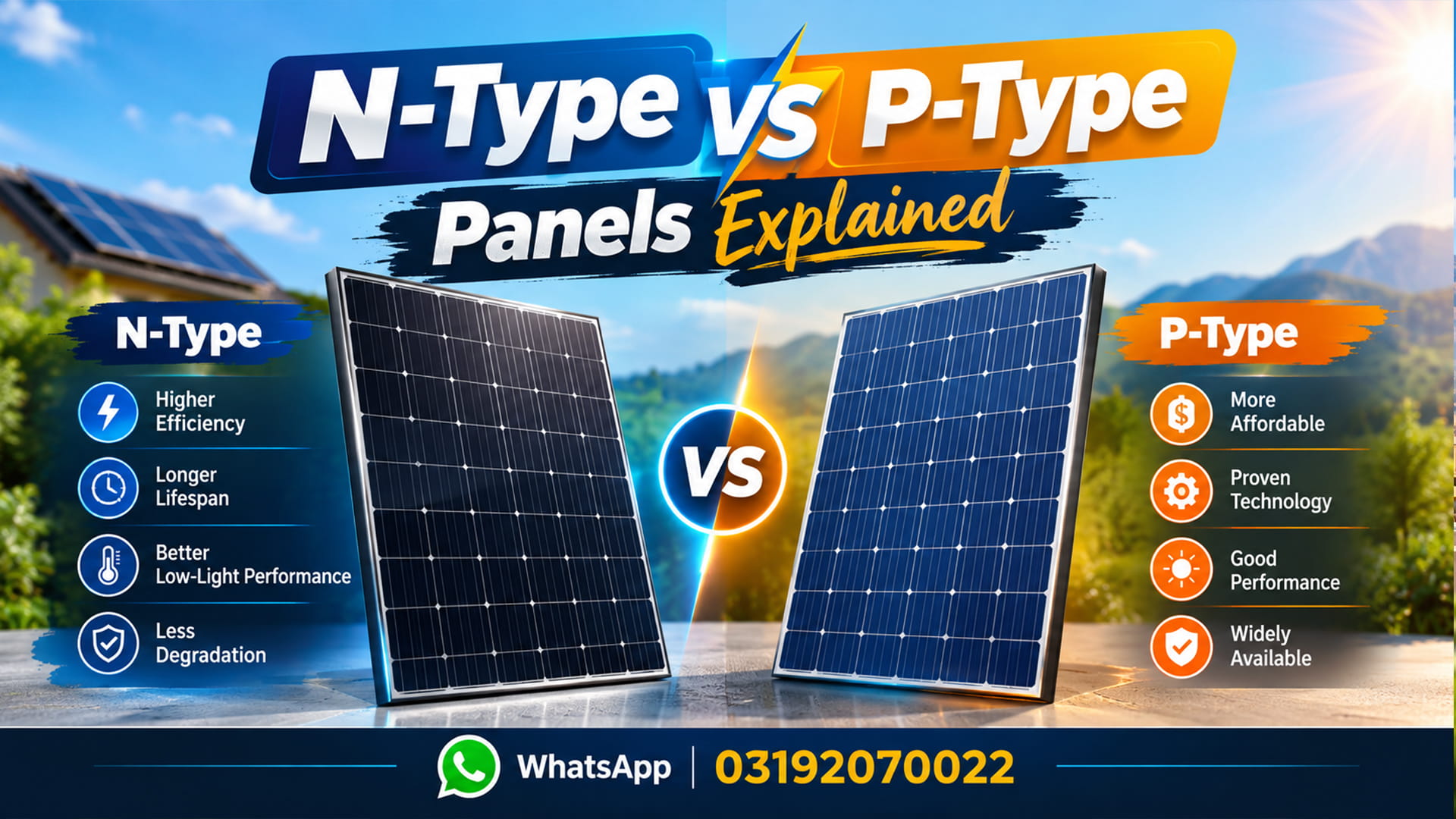
Every solar panel quote you get in Pakistan will mention one of these two letters somewhere, and most buyers nod along without really knowing what the difference means for their roof. It is not marketing jargon. It describes a real difference in how the silicon inside the cell is made, and that difference shows up directly in your electricity bill over the next twenty-five years.
The short version: N-type is the newer, better-performing technology, and it has become the mainstream standard. P-type is the older technology, still made, still sold, and still reasonable in specific situations, but on the way out of premium product lines industry-wide.
The rest of this guide explains why, in plain terms, and what it actually means when you are standing in a market in Saddar or Hall Road deciding between two panels that look identical.
What N-type and P-type actually mean
Every solar cell is a wafer of silicon that has been deliberately contaminated, or “doped,” with a trace element to give it useful electrical properties. Which element you add determines the type.
P-type silicon is doped with boron. This has been the standard approach for most of the solar industry’s history because it is cheaper and simpler to manufacture. Most PERC panels, the dominant technology through the 2010s and into the early 2020s, are built on P-type wafers.
N-type silicon is doped with phosphorus instead. It costs a little more to produce, requires tighter control during manufacturing, but the resulting wafer holds its electrical charge more efficiently and for longer. TOPCon, HJT and back-contact cell technologies, the ones currently marketed as the premium options from Longi, Jinko, JA Solar, Trina and most other Tier-1 brands, are all built on N-type wafers.
That single choice, boron or phosphorus, is the root of every performance difference discussed below.
Why the doping choice actually matters
Phosphorus is chemically more stable than boron when exposed to light and oxygen together. Boron-doped silicon has a tendency, under sustained sunlight, to form a boron-oxygen defect inside the cell structure. This defect traps some of the electrical charge the cell is trying to generate, and it appears as a measurable drop in output within the first months of use. It is called light-induced degradation, or LID, and it is close to unavoidable in P-type cells.
N-type cells do not form this defect, because there is no boron to react. That single chemical fact is why N-type panels have a flatter degradation curve from day one.
There is a second, related effect worth understanding. Inside a solar cell, sunlight knocks electrons loose, and those electrons need to survive long enough to be collected as current before they recombine back into the silicon and are lost as heat instead of electricity. This survival time is called the carrier lifetime. N-type silicon, because it has fewer of the defects that cause premature recombination, gives electrons a meaningfully longer carrier lifetime. Practically, that means more of the light hitting an N-type cell actually becomes usable electricity, which is the core reason N-type cells post higher efficiency figures than P-type cells built to a similar design otherwise.
The numbers side by side
| Property | P-type (PERC) | N-type (TOPCon / HJT / back-contact) |
|---|---|---|
| Wafer dopant | Boron | Phosphorus |
| First-year degradation (LID) | 1.5% to 2.5% | Under 1%, often under 0.5% on premium lines |
| Annual degradation after year one | 0.5% to 0.7% | 0.35% to 0.45% typical |
| Cell efficiency | roughly 22% to 23.5% | roughly 24% to 26%+ |
| Temperature coefficient | -0.35% to -0.40%/°C | -0.26% to -0.30%/°C |
| Bifaciality factor | 65% to 75% | 80% to 90%+ |
| PID resistance | Standard, needs process controls | Inherently stronger |
| Typical 25-year retained output | 80% to 84% | 87% to 90%+ |
| Manufacturing cost | Lower | Higher, though the gap has narrowed sharply |
Published figures vary between manufacturers and between different sources reporting on them, so treat this table as a representative range rather than an exact figure for any specific panel. The direction of every row, however, is consistent across manufacturer datasheets and independent testing: N-type wins on every performance line, and P-type wins on upfront cost.
What this means specifically for Pakistan
Two things make Pakistan a demanding test for solar technology: heat and net billing. Both push the decision toward N-type more strongly than they would in a milder climate.
Heat. Roof surface temperature across Punjab, Sindh and Balochistan routinely reaches 60 to 70°C on a June or July afternoon, well above the 25°C reference point every panel is rated at. The temperature coefficient tells you how much power is lost per degree above that reference. A P-type panel at roughly -0.38%/°C loses somewhere around 15 to 17 percent of its rated output at 65°C cell temperature. An N-type panel at roughly -0.28%/°C loses closer to 11 to 12 percent under the same conditions. On a 5kW array, that gap is worth a genuinely noticeable number of units across a summer, precisely the season when your bill and your AC load are both at their highest.
Net billing. Since NEPRA’s Prosumer Regulations 2026 took effect on 9 February 2026, exported surplus is bought back at roughly Rs 8 to Rs 11 per unit, while grid imports cost your full slab tariff, often Rs 40 to Rs 60. Every unit your system fails to produce because of degradation or heat loss is now a unit you buy back at full price rather than a unit you were merely exporting cheaply. The gap between N-type and P-type retained output, roughly 5 to 8 percentage points over 25 years, is worth considerably more today than it would have been under the old net metering framework.
Degradation, worked through on a real system
Take a 10kW array, roughly 1,150 to 1,400 units a month in typical Pakistani conditions, generating around 1,250 units a month at installation.
A P-type PERC system degrading at roughly 2 percent in year one and 0.6 percent annually after that retains around 82 percent of its original output by year 25, generating roughly 1,025 units a month by that point.
An N-type system degrading at roughly 1 percent in year one and 0.4 percent annually after that retains around 88 to 89 percent of its original output by year 25, generating roughly 1,105 units a month.
That gap, around 80 units a month by year 25, is worth roughly Rs 3,200 to Rs 4,800 a month at current tariffs, every month, for the back half of the system’s life. It compounds slowly and invisibly, which is exactly why it is so easy to underweight when you are standing in a shop comparing two rupee-per-watt figures.
For a full costed 10kW build, see our 10kW solar system price in Pakistan breakdown.
Bifacial performance
N-type cells naturally support a higher bifaciality factor, the percentage of a bifacial panel’s front-side output that the rear side can also generate under the right conditions. N-type dual-glass modules commonly reach 80 to 90 percent bifaciality. P-type bifacial panels exist but generally sit lower, closer to 65 to 75 percent.
This only matters if your installation actually supports it: a raised structure, light-coloured or reflective ground underneath, genuine clearance. A high-bifaciality N-type panel flush against dark concrete performs close to a mono-facial panel regardless of what the datasheet promises. The technology sets the ceiling; the installation decides whether you reach it.
Price: the gap has mostly closed
A few years ago N-type carried a real premium, commonly 20 to 30 percent above equivalent P-type stock. That gap has narrowed sharply as N-type manufacturing has scaled globally, and in Pakistan today the difference between a standard N-type panel and a comparable P-type one is often just a few rupees per watt, sometimes less.
Current market reference rates:
| Category | Rate (PKR/watt) |
|---|---|
| N-type TOPCon or HPBC, standard Tier-1 | 40 – 45 |
| N-type, premium back-contact lines | 44 – 48 |
| P-type PERC, still-available stock | 32 – 40 |
At this narrowed gap, the extra you pay for N-type is usually recovered within a few years through better heat performance and slower degradation alone, well inside the system’s 25-year life. For the wider brand-by-brand picture, see our solar panel price in Pakistan today guide.
Where P-type still makes sense
It is not obsolete everywhere, and it is worth being honest about where it still fits.
Budget-constrained agricultural and off-grid use. A tube well or a shed does not need 25-year premium longevity, and P-type stock is genuinely cheaper.
Cooler climates and shaded sites. The temperature coefficient advantage of N-type matters most where cells actually get hot. On a well-ventilated, partly shaded, or naturally cooler installation, the gap narrows.
Where documented, genuine P-type is available and N-type is not, or is priced unreasonably. A documented P-type panel from a real manufacturer is a legitimate product. It is not a scam. It is simply the older generation.
What is not reasonable is paying an N-type price for a P-type panel because a seller described it loosely. This is the single most common deception in the Pakistani panel market right now, and it has nothing to do with counterfeiting. The panel is completely genuine. Only the description is wrong.
The trap: how sellers blur the line
Ask a dealer whether a panel is N-type or P-type and you will very often get a confident “yes, bifacial N-type” regardless of what is actually on the nameplate. Bifacial and N-type are not the same thing. Plenty of P-type panels are also bifacial, dual-glass, and visually indistinguishable from an N-type module on a showroom floor.
The only reliable way to know is the model code. Every manufacturer publishes which series use which cell technology. Get the exact model code in writing, then look it up on the manufacturer’s own site rather than trusting a verbal description. Longi’s Hi-MO X10 and Hi-MO 7 lines are N-type. Jinko’s Tiger Neo line is N-type. Both companies also still sell older P-type series into price-sensitive markets, correctly labelled on their own datasheets even when a dealer’s verbal pitch blurs it.
How to verify a panel’s model code and cell technology against the manufacturer’s own records is covered in detail in our how to spot fake or B-grade solar panels guide, and the wider question of grade and documentation is covered in our A-grade vs B-grade solar panel prices breakdown.
N-type sub-technologies, briefly
Not all N-type is identical. Three variants are relevant to what is sold in Pakistan.
TOPCon (tunnel oxide passivated contact) is the current mainstream N-type technology and the one behind most Tier-1 modules sold here, including Jinko’s Tiger Neo line and JA Solar’s, Trina’s and Canadian Solar’s current N-type series. Strong efficiency, well-proven at scale, widely available.
HPBC or back-contact moves the cell’s metal contacts to the rear of the wafer, removing the small shading loss caused by front-side busbars on conventional cells. Longi’s Hi-MO X10 series uses this approach. Slightly higher efficiency ceiling than standard TOPCon, at a modest additional cost.
HJT (heterojunction) combines crystalline and amorphous silicon layers and currently posts the best lab efficiency and temperature coefficient figures of the three, though it remains less common in the Pakistani retail market than TOPCon or back-contact.
For most buyers in Pakistan today, the practical choice is between TOPCon and HPBC, both genuinely strong options. Specifications for the two most common high-output examples of each are in our Longi 645W price and specs and Jinko 720W price and specs write-ups, and a direct comparison of how the two brands perform in local conditions is in our Longi vs Jinko guide.
How to decide
If you are installing on a roof you plan to keep for the long term, and your budget allows a difference of a few rupees per watt, N-type is the sensible default in Pakistan’s climate. The heat performance and degradation advantage compound over 25 years in a way that a small upfront saving does not offset, particularly under net billing where every unit you fail to generate costs you the full retail tariff rather than the low export rate.
If you are solarising a tube well, a boundary wall, or a temporary site where 25-year performance is irrelevant and budget is the binding constraint, documented P-type remains a reasonable choice, provided it is genuinely documented and correctly described.
What you should never accept is an N-type price for a panel whose model code says P-type, or a confident verbal assurance in place of a written model number you can verify yourself.
Buying from BuySolars
We stock both current-generation N-type modules and documented P-type stock, with the cell technology and exact model code confirmed in writing before you pay, and nationwide delivery across Pakistan.
Current stock and wattages are on our products page. Tell us your roof size, budget and whether the installation is residential or agricultural, and we will recommend the technology that actually fits rather than defaulting to whichever we have most of.
On storage, lithium rates move too fast to publish usefully. WhatsApp us now for the latest price of the battery at 03192070022.
The silicon is doped with a different element, phosphorus for N-type and boron for P-type. That single difference drives higher efficiency, slower degradation and better heat performance in N-type cells.
On performance, yes, across every published metric. On upfront cost, P-type is cheaper, though the gap has narrowed to a few rupees per watt in most cases.
Roughly Rs 5 to Rs 10 per watt more than comparable P-type stock at current market rates, a much smaller gap than a few years ago.
Yes. N-type’s lower temperature coefficient means it loses proportionally less output at the 60 to 70°C cell temperatures common on Pakistani roofs in summer.
Yes. Bifacial and N-type are separate features. A panel can be P-type and bifacial, which is a common source of confusion when dealers describe stock verbally.
Check the exact model code against the manufacturer’s own datasheet. The nameplate description alone, or a dealer’s verbal claim, is not reliable.
Yes, for budget-constrained, short-horizon or off-grid applications like tube wells and sheds, provided it is genuinely documented.
The short version
N-type panels use phosphorus-doped silicon instead of boron, which removes the light-induced degradation that limits P-type cells and gives N-type a real, measurable advantage in efficiency, heat performance and long-term output. In Pakistan’s climate, and under the current net billing framework, that advantage is worth more than it would be almost anywhere else. The price gap has narrowed enough that N-type is the sensible default for a house roof, with P-type remaining a reasonable choice only for low-stakes, budget-driven applications.
Whichever you choose, verify the model code before you pay. The nameplate tells the truth. The sales pitch does not always.
WhatsApp 03192070022 for today’s confirmed rates on both N-type and P-type stock.