
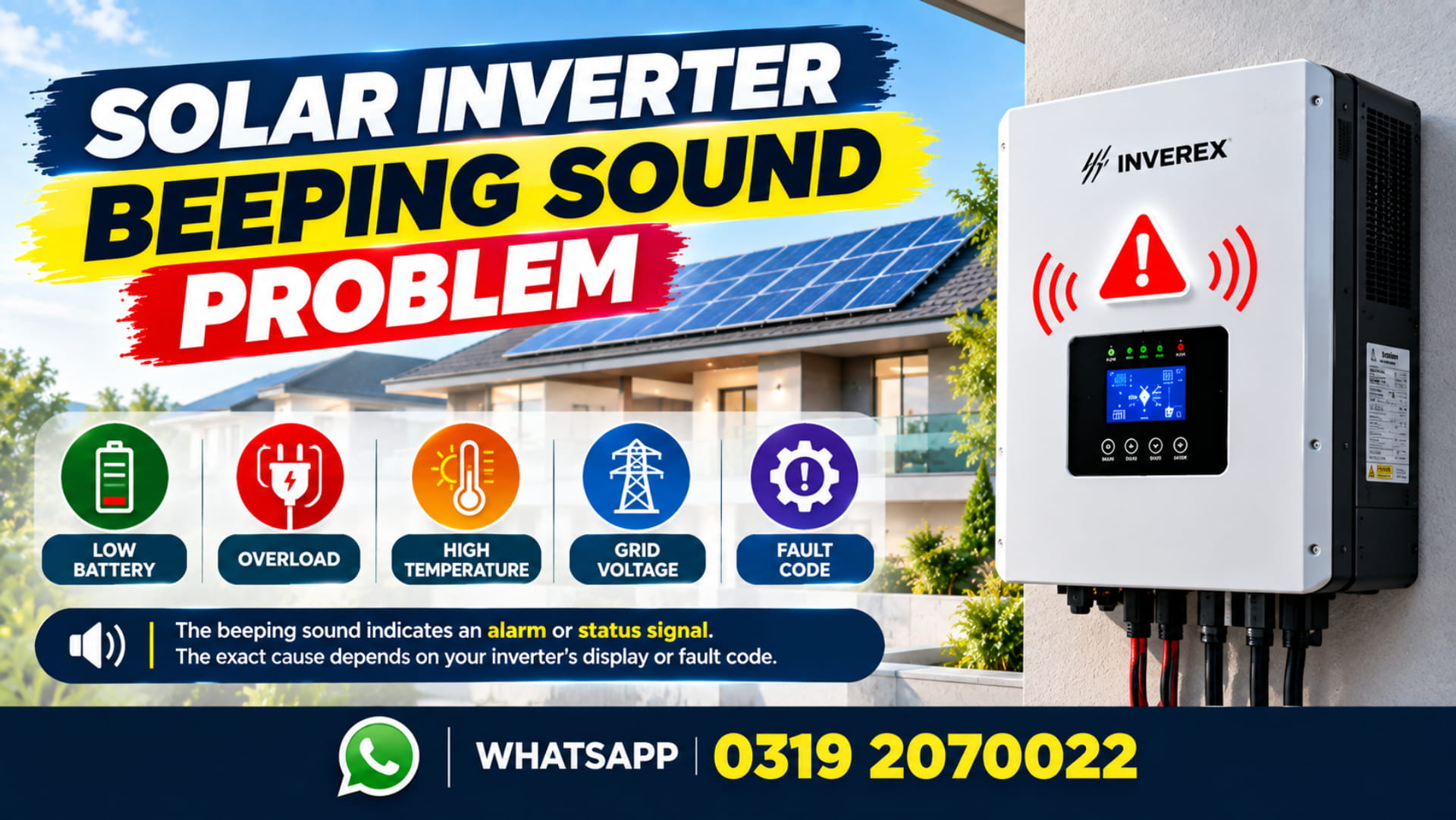
A beeping inverter is not random noise. It is your inverter’s alarm system telling you something specific, and in the large majority of cases the cause is minor and fixable in a few minutes without calling anyone. A smaller number of causes genuinely need a technician.
The trick is telling the two apart, and that starts with reading what the beep is actually paired with, not just the sound itself.
Fault codes, beep patterns and alarm thresholds vary by brand and model, so treat the causes below as the common list you will run into on Inverex, Solis, Growatt, Must, TBB and Voltronic-based inverters running in Pakistan, then check your own unit’s manual or LCD for the exact code.
If the fault turns out to involve the battery, note that we never quote lithium prices in writing since rates move too fast. WhatsApp us now for the latest price of the battery at 03192070022 if replacement comes into the picture.
Why inverters beep in the first place
Every inverter sold in Pakistan, from a basic UPS-style unit to a full hybrid, carries a small fault-and-warning system. When something falls outside a safe operating range, the inverter does two things at once: it shows a code or icon on its LCD or LED panel, and it beeps, because a beep gets your attention even when nobody is standing in front of the display.
Two categories matter here. An informational beep is not a problem: a single short beep at startup, at shutdown, or when the grid supply is restored is just the inverter confirming a state change. An alarm beep is different: it repeats, it is usually paired with a flashing light or an error code, and it means the inverter wants a specific condition corrected.
The most common causes, one by one
Grid failure / mains fail alarm. This is the single most common beeping complaint on on-grid inverters in Pakistan, precisely because it is tied to loadshedding rather than to a fault in the unit itself. On-grid inverters are required, for safety reasons, to shut down the moment grid supply is lost, since they cannot legally keep feeding power into a line that utility staff may be working on. Many models beep for a few seconds before that shutdown. If your beeping lines up exactly with a power cut, this is normal behaviour, not damage. It also explains why a plain on-grid system gives you zero backup during loadshedding, a point covered in detail in our solar par AC chalega ya nahi guide.
Low battery voltage alarm. Hybrid and off-grid inverters beep when battery voltage drops toward the low cutoff point, protecting the battery from over-discharge. This happens most often during long loadshedding stretches when the battery has been running the house for hours with limited solar input, or when a battery bank is undersized for the actual load it is asked to carry. Correct sizing against your real appliance list is covered in our solar ke liye kitni battery chahiye guide.
Overload alarm. The inverter is being asked to supply more load than its rated capacity. A common Karachi scenario: a 3kW inverter running a 1.5 ton AC, an iron, a motor and lights all at once. The AC’s startup surge alone, two to three times its running load, can trip this alarm even if the running total looks fine on paper. If AC load is the recurring trigger, our solar panels for 1 ton AC guide walks through the sizing math properly.
Over-temperature alarm. Inverters generate heat, and if the unit sits in an enclosed cupboard, in direct sun, or in a poorly ventilated room, internal temperature climbs until the fault trips. This is more common in Punjab and interior Sindh summers than in cooler regions, and it gets worse over the years as dust accumulates on the heatsink and vents.
Fan fault. Most inverters cool themselves with a small internal fan. After several years of dust exposure, especially in Pakistan’s dustier cities, that fan can seize or fail outright, which the inverter detects and flags with a beep and a fault code. Inverters typically last eight to twelve years before major component wear like this becomes common, a lifespan comparison covered in our solar panel kitne saal chalta hai guide, which also covers how inverter life compares with panel and battery life.
Earthing or ground fault alarm. Poor earthing at installation time, a loose earth connection, or moisture getting into a junction box can all trigger a ground fault alarm. This is one of the more serious ones on the list, because bad earthing is a genuine safety issue, not just a nuisance. Correct earthing procedure is part of a proper installation, covered in our solar panel installation in Karachi guide, and the same principles apply nationwide.
PV over-voltage. On cold mornings, panel open-circuit voltage rises above its rated figure at 25°C, sometimes enough to exceed the inverter’s maximum DC input voltage if the panel string was sized too aggressively. This shows up as a beep and an over-voltage code specifically in winter and early morning, then clears once the panels warm up. It points to a string design issue rather than a hardware fault, worth checking against your hybrid inverter specifications with your installer.
Battery communication error. Hybrid inverters paired with lithium batteries talk to the battery’s BMS over a CAN bus or RS-485 connection. If that communication cable is loose, damaged, or the battery brand’s protocol was never matched properly to the inverter, you get a persistent beep and a communication fault code rather than a voltage-related one. This is a setup issue more than a battery health issue, and it is one of the reasons BMS compatibility matters when choosing a lithium battery in the first place.
Normal startup or shutdown beep. A single short beep when you switch the inverter on, when it switches to battery, or when grid power returns, is just a status confirmation. If it happens once and stops, there is nothing to fix.
Reading the beep pattern
Exact patterns differ by brand, but as a rough general guide across the common models sold in Pakistan:
| Pattern | Usually means |
|---|---|
| Single short beep | Status change, informational, no action needed |
| Continuous steady beep | Active alarm condition, check the LCD code immediately |
| Repeated short beeps every few seconds | Ongoing warning, often overload or temperature |
| Beep with red LED and specific error number | Look up that exact code in your model’s manual |
| Beep only during power cuts | Almost always grid-failure behaviour, normal for on-grid units |
Treat this table as a starting point rather than gospel. The safest move if you are unsure is to note the exact fault code shown on the display and share it with your installer or with us on WhatsApp, since the code narrows the cause far faster than the sound alone.
A step-by-step troubleshooting checklist
Work through these in order before assuming the worst.
- Read the LCD or app fault code first. Almost every inverter sold here shows a code alongside the beep. This alone usually tells you which of the causes above applies.
- Check battery voltage or state of charge, either on the inverter display or a companion app if your model has one.
- Temporarily switch off a few heavy appliances and see if the alarm clears. If it does, you were looking at an overload condition.
- Check ventilation around the inverter. Make sure vents and the fan intake are not blocked by dust, boxes, or direct sun exposure, and clean visible dust off the casing.
- Inspect visible DC and AC connections for looseness, discoloration, or a burnt smell. If you smell burning or see scorch marks, stop here, power off, and call a technician immediately rather than continuing to troubleshoot yourself.
- Check the earthing connection if a ground fault code is showing, or ask your installer to verify it if you cannot inspect it safely yourself.
- If the alarm persists after all of the above, photograph the fault code and the inverter model plate, and contact your installer or WhatsApp us with both. That single photo usually cuts diagnosis time to a couple of minutes.
When it is dangerous versus just a nuisance
Most beeping falls into the nuisance category: grid-failure beeps during loadshedding, overload alarms from running too much at once, or a fan fault that just needs a cleaning or replacement. These are annoying but not urgent, and several of them are things you can clear yourself using the checklist above.
A smaller set of causes are genuine safety issues and should not wait: a burning smell, visible smoke or scorch marks, a breaker that trips repeatedly the moment you reset it, or a ground fault alarm on a system where you cannot verify the earthing. In any of these cases, power the system down at the isolator and call a technician rather than experimenting further.
Preventing the problem from recurring
A properly sized, properly installed, and properly maintained system beeps rarely, and almost never for a serious reason. A few habits make the real difference over the system’s life:
Get the system sized correctly from the start, both on the panel side and the inverter side, so overload alarms do not become a weekly event. Our 10kW solar system price in Pakistan guide breaks down how component choices affect this. Keep the inverter in a ventilated, shaded location rather than a sealed cupboard. Clean dust off the casing and vents every few months rather than waiting for a fault to force the issue. And get an annual checkup that includes the earthing, DC connectors and fan, the same annual habit that extends panel life as covered in our lifespan guide linked above.
Getting it fixed through BuySolars
If you have checked the fault code and the basics above and the beeping continues, send us the model number, the exact fault code shown, and a photo of the inverter over WhatsApp. Most beeping issues are diagnosed correctly within minutes once we have the code rather than just a description of the sound.
We also stock replacement hybrid and on-grid inverters with nationwide delivery, in case the fix turns out to be a unit that has genuinely reached the end of its service life. Current stock is on our products page, and you can reach our team directly through our contact us page as well.
A continuous beep almost always pairs with an active alarm code on the display, most commonly overload, low battery voltage, over-temperature, or a ground fault. Check the LCD code first to identify which one applies.
Yes, for on-grid inverters. They are required to shut down when grid supply is lost, and many models beep briefly during that shutdown. This is expected behaviour, not a fault.
Overload, temperature and dust-related beeps are usually safe to troubleshoot yourself using the checklist above. Anything involving a burning smell, scorch marks, or a repeatedly tripping breaker should go to a technician instead.
Not necessarily. A low-voltage alarm often just means the battery is discharged and needs to recharge, or that the load connected is larger than the battery bank is sized for. A communication error is usually a wiring or protocol mismatch rather than battery damage.
Most hybrid and on-grid inverters run reliably for eight to twelve years before major component wear, such as fan failure, becomes common. Beeping well before that age is more likely a setup or environmental issue than end-of-life failure.
The short version
A beeping inverter is a message, not a mystery. Read the code on the display before assuming the worst, work through overload, temperature, battery and earthing checks in order, and reserve technician calls for anything involving heat, smoke or a repeatedly tripping breaker. Most beeping problems in Pakistani homes trace back to loadshedding-driven grid alarms, dust-related overheating, or a system that was undersized for its actual load, all of which are fixable once identified correctly.
WhatsApp 03192070022 with your inverter’s fault code and model number for a fast, accurate diagnosis.