
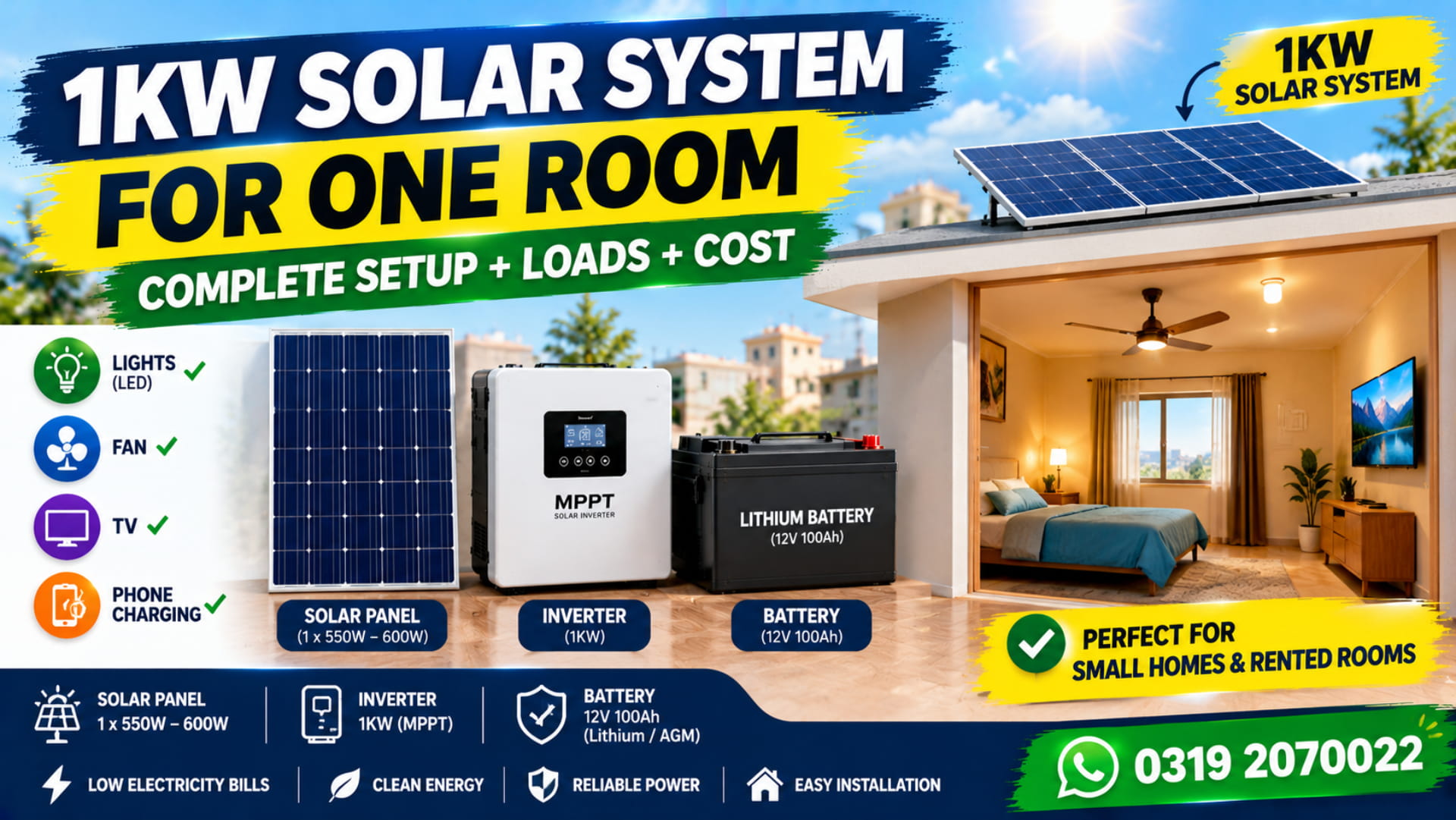
A 1kW solar system is enough to run everything in a typical single room except a full day of air conditioning. Fans, LED lights, a television, a laptop, a router and phone charging fit comfortably. An inverter air conditioner is the awkward one, and the honest answer depends on how many hours you expect it to run and whether you have a battery.
This guide adds up what a room actually draws, shows what a 1kW array produces in a day, and then works through the choices that decide whether the system feels like a success or a disappointment: panel count, inverter size, battery, and whether the AC is in or out.
What “1kW” means, and what it produces
The 1kW refers to the panel capacity, the combined rated output of the panels in full sun. It is not the power available at every moment, and it is not the same as the inverter rating.
In Pakistan, 1kW of installed panels typically produces about 4 to 5 units (kWh) a day averaged over the year, roughly 120 to 150 units a month. Karachi sits in that range, with coastal haze and dust trimming a little off the datasheet figure. Summer days produce more, winter days and the monsoon produce less. A unit here is the same unit your electricity bill counts.
| Season | Approximate daily output from 1kW of panels |
|---|---|
| Summer (April – June) | 5 – 6 units |
| Monsoon (July – September) | 3 – 4.5 units |
| Autumn (October – November) | 4.5 – 5 units |
| Winter (December – February) | 3.5 – 4.5 units |
Think of it as a daily budget of about four to five units that arrives mostly between 9am and 4pm. Everything else in this guide is about spending that budget well.
What a single room draws
Add up the appliances you actually use, with realistic hours, rather than the number of sockets.
| Appliance | Typical power | Typical daily use | Units per day |
|---|---|---|---|
| Ceiling fan (AC motor) | 70 – 80W | 10 hours | 0.7 – 0.8 |
| DC / BLDC fan | 25 – 35W | 10 hours | 0.25 – 0.35 |
| LED lights (3 bulbs) | 30W total | 5 hours | 0.15 |
| Television (LED) | 80 – 120W | 4 hours | 0.35 – 0.5 |
| Laptop | 50 – 70W | 6 hours | 0.3 – 0.4 |
| Wi-Fi router | 10 – 15W | 24 hours | 0.25 – 0.35 |
| Phone charging | 10 – 20W | 3 hours | 0.03 – 0.06 |
| Small desk fan or table lamp | 20 – 40W | 4 hours | 0.1 – 0.15 |
| Inverter AC, 1 ton | 700 – 1,200W | 5 hours | 3.5 – 4.5 |
| Non-inverter AC, 1 ton | 1,200 – 1,500W | 5 hours | 6 – 7 |
A room without air conditioning, running a fan, lights, TV, laptop, router and charging, uses roughly 1.7 to 2.2 units a day. That is well under half of what a 1kW array produces, which leaves a healthy margin for cloudy days and losses.
Adding a one-ton inverter air conditioner for five hours brings the total to around 5.5 to 6.5 units a day, which exceeds a 1kW array’s daily output. A non-inverter AC pushes it far beyond. This is the arithmetic that decides everything.
So can a 1kW system run an AC?
Partly, depending on how you use it. The sizing logic for air conditioning is covered in our solar panels for 1 ton AC guide, and the short version applies here.
Energy is only half the problem. Even if the daily total worked out, a one-ton AC draws 700 to 1,200W while running, and a compressor start can briefly draw two to three times that. A 1kW panel array delivers its full rated output only at peak sun, so an AC running directly from panels would stop and start as clouds pass. The inverter has to cope with the start-up surge, and a small inverter will trip. This is the overload problem explained in our inverter overload problem solution guide.
What works in practice.
| Setup | What it does |
|---|---|
| 1kW panels, grid-tied, AC on grid | Panels cut your bill by supplying the fan, lights and electronics, while the AC runs from the grid. Simple and economical. |
| 1kW panels + hybrid inverter of 1.5 – 2kW, no battery | The AC can run during sunny hours, topped up from the grid when solar dips. The inverter must be sized for the AC surge, not just the panels. |
| 1kW panels + inverter + battery | Fans, lights and electronics run through the evening and during outages. The AC is limited to daytime or short use. |
| 2kW panels + hybrid inverter | A more realistic base for regular daytime AC use in one room. |
If daytime air conditioning is the main reason you want solar, a 1kW array is a modest contribution rather than a full solution, and it is worth considering 2kW. If your priority is fans, lights and electronics, with or without outage backup, 1kW is well matched.
Panels: how many for 1kW
A modern panel is rated at 600 to 650 watts, so a 1kW requirement is met by two panels, giving about 1.2 to 1.3kW of capacity. That is slightly more than 1kW, which is no bad thing, since real output is always below the nameplate.
At typical Pakistani rates of Rs 44 to Rs 48 per watt for high-output modules, two 645W panels cost roughly Rs 57,000 to Rs 62,000. Rates move with the dollar and container arrivals, so confirm the current figure on WhatsApp.
Two panels need about 5.5 square metres of roof, balcony frame or ground space, with a small clearance around them. That is manageable on most roofs, a terrace corner or a car-port.
The inverter: the part people size wrongly
For a one-room system the inverter matters more than the panels, because it decides what can run.
For fans, lights and electronics only, a small 1kVA to 1.5kVA hybrid or off-grid inverter is enough.
If you want the AC to run from solar, the inverter should have a continuous rating and surge capacity above the AC’s start-up draw, typically 1.5 to 2kW or more, even though the panel array is only 1kW. An undersized inverter is the commonest reason a small system seems to disappoint.
On-grid, hybrid or off-grid.
- On-grid (grid-tied) inverters are the cheapest and give the quickest payback, but they shut down when the grid fails, so they give no backup.
- Hybrid inverters work with a battery and the grid, so fans and lights continue during outages. The pricing and features of the hybrid options available in Pakistan are covered in our hybrid inverter price in Pakistan guide.
- Off-grid inverters run entirely from panels and battery, suited to places without reliable grid power.
Under current net billing rules, units you use yourself are worth your full slab tariff, while exported units earn far less. A one-room system is small enough that nearly all its output is consumed on site, which is exactly the situation where solar pays best.
Battery: do you need one?
If outages are frequent or you work or study in the room in the evening, a battery is worth considering. If outages are rare and you mostly use the room in daylight, you can skip it.
Sizing the battery. Add up what you need to run when the sun is down. A fan, lights, router and a laptop for an evening and night might use 0.8 to 1.2 units. Because a lithium battery should not be run to empty, you want roughly 1.5 to 2 kWh of nominal capacity to deliver that comfortably. Add the TV or a second fan and the number rises. The method for working out the right capacity is set out in our lithium battery guide.
Battery pricing varies by chemistry, brand and capacity, and moves quickly. WhatsApp us now for the latest price of the battery at 03192070022.
Why not a larger battery? A 1kW array produces about four to five units a day. After the daytime loads are served, only a modest amount is left to charge the battery. A battery much larger than your array can recharge in a day is wasted money.
A worked example
A student in a rented room in Karachi runs a fan, three LED bulbs, a laptop, a router, phone charging and an occasional TV. Daily use comes to about two units, and the room has roughly three hours of outage most evenings.
- Panels: two 645W panels, about 1.3kW.
- Inverter: a 1.5kVA hybrid inverter.
- Battery: about 2kWh nominal lithium battery, enough for the three-hour outage and light night use.
- Result: daytime use runs directly from solar, the battery covers outages and the evening, and the grid is used only when the battery runs low. The monthly saving depends on the tariff, but the room’s units are largely offset, and the router and lights keep running through load shedding.
If the same student adds a one-ton inverter AC for five hours each afternoon, the daily total rises to about six units. A 1kW array no longer covers it, and the sensible options are to move to 2kW or to accept that the AC will draw from the grid on weaker days.
What it costs, and the payback
Costs depend on whether you include a battery and which inverter you choose. Panels are the smallest part of the bill in a system this small, and the inverter and battery dominate. Because of this, a one-room system is more expensive per kilowatt than a larger one, and payback is slower than for a whole-house system. A room that uses only a couple of units a day saves modest amounts each month, so work out the payback before committing.
For a quote that includes everything — panels, inverter, structure, cabling, protection and installation — send us your appliance list and whether you want backup, and we will price it. If you rent, agree the arrangement with your landlord in writing before buying.
Practical tips for a small system
Choose efficient appliances. A DC or BLDC fan uses about a third of the power of a standard ceiling fan, and an inverter AC uses roughly half that of a non-inverter unit. Efficiency lets a small system stretch much further.
Run heavy loads in daylight. Iron, washing machine and pump belong in the sunny hours, not the evening.
Mount for the sun. Panels face south, tilted at roughly the latitude of your city, with no shade from walls, tanks or trees.
Keep the panels clean. Dust can cut output by several percent, and in Karachi it needs washing every couple of weeks.
Do not overspend on the structure or battery. Match each to your actual use, and leave room to expand, since adding a second pair of panels later is straightforward if the inverter is sized for it.
Getting a quote through BuySolars
Send us your appliance list, your usual hours of use, how often you face outages and whether you want to run an AC, and we will recommend a panel count, inverter and battery for the room. We deliver across Pakistan with nationwide delivery, and current stock is on our products page.
WhatsApp 03192070022 with your appliance list for a one-room solar quote.
Yes, fans, lights, TV, laptop and router fit comfortably within its daily output.
Only partly. A one-ton inverter AC uses more energy than a 1kW array makes in a day, so expect daytime or short use.
Two modern 600–650W panels, giving about 1.2–1.3kW of capacity.
Only if you face frequent outages or use the room in the evening.
Typically 4 to 5 units, a little less in monsoon and winter.