
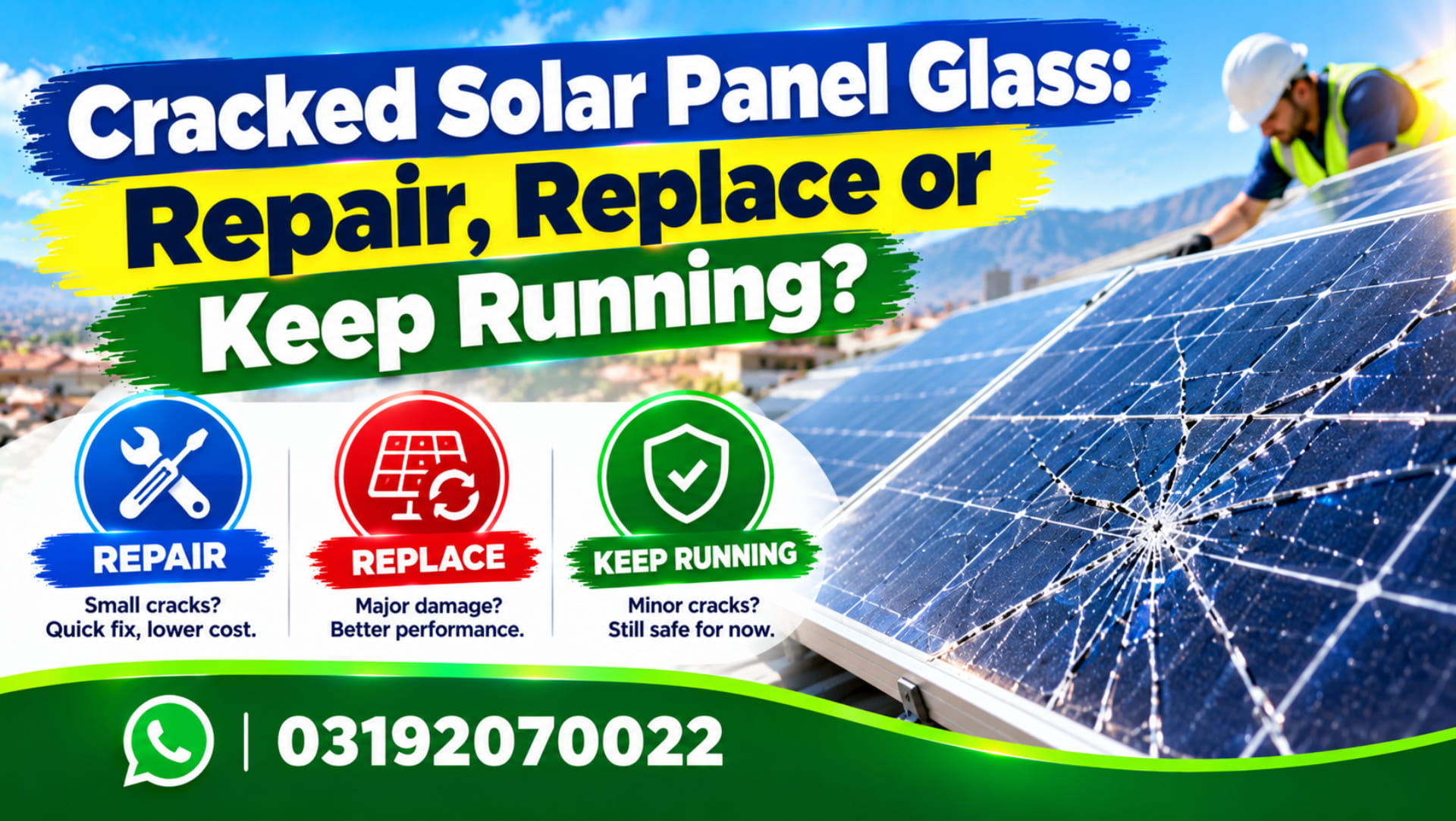
A cracked panel is not automatically a dead panel, and it is not automatically safe to ignore either. The right answer depends on exactly where the crack sits, how far it has spread, and whether moisture has already started working its way into the laminate underneath. A hairline crack at the edge of the frame, away from any cell, can sometimes keep producing with little immediate loss. A spider-webbed or shattered panel, or one showing discolouration spreading out from the crack, should be taken out of service rather than left running on the hope that it holds.
This guide explains what causes cracked glass, how to judge how serious a given crack actually is, why a quick sealant fix is not the same as a real repair, and when replacement is the only sound option.
What causes cracked glass
Hail impact is a genuine cause in parts of Pakistan during storm season, and the size and velocity of hail that can crack tempered solar glass varies by panel quality, which is one reason tier-1 panels are generally more resistant than lower-tier alternatives.
Falling debris, a branch, construction material from a nearby site, or anything dropped from above, is a common and often preventable cause, particularly on roofs near trees or ongoing building work.
Impact during transport or installation happens more often than most buyers realise, particularly with panels handled carelessly before they ever reach the roof. A crack discovered shortly after installation, with no storm or debris event in between, often traces back to this rather than anything that happened on-site after mounting.
Foot traffic is a frequent and entirely avoidable cause. Panels are not designed to be walked on, and a technician or anyone else stepping directly on the glass during maintenance or an unrelated roof job is a common source of cracks that only become visible later.
Lower-quality glass on some lower-tier panels is simply thinner or less consistently tempered, making it more prone to cracking from stresses a tier-1 panel would absorb without damage. The difference in build quality between tiers is covered in our A-grade vs B-grade solar panels guide.
How to judge how serious a crack actually is
Location relative to the cells. A crack confined to the border area outside the active cell grid is less immediately concerning than one running directly across one or more cells, since cell-area damage is far more likely to affect both output and the integrity of the electrical circuit beneath the glass.
Extent and pattern. A single hairline crack is a different situation from a spider-webbed or shattered area. The more the glass has fractured into multiple pieces, the greater the risk that pieces have shifted and compromised the seal beneath them.
Any sign of moisture already inside. Discolouration spreading outward from the crack, a cloudy or foggy appearance under the glass near the damage, or a bubbled patch of backsheet are all signs that moisture has already breached the laminate, which changes this from a watch-and-monitor situation into one that needs attention promptly.
Output change. Compare the affected panel or string’s output against unaffected panels under the same conditions. A meaningful, sustained drop confined to the damaged panel confirms the crack is affecting performance, not just appearance.
Why moisture is the real long-term danger
The glass itself is only part of what protects a solar cell. Underneath it sits a sealed laminate designed to keep the cells, the circuitry connecting them, and the backsheet completely isolated from humidity and water. Once that seal is broken, even by a crack that looks minor and shows no immediate output loss, moisture begins working its way in gradually, especially during Karachi’s humid stretches and the monsoon. Over months, this moisture ingress causes delamination, corrodes the fine circuitry connecting the cells, and can eventually create a localized heating point as a corroded connection develops resistance and begins to heat under load, the same mechanism behind a cell-level hotspot developing from an entirely different starting cause.
This is why “it still seems to be working fine” is not the same as “it is fine.” A cracked panel showing no symptoms today can still be accumulating damage that shows up as a sudden output drop, or worse, months later.
Can you keep running a cracked panel?
In limited cases, yes, cautiously and temporarily. A minor, hairline crack confined to the border area, away from any cell, with no visible moisture ingress and no measurable output change, can often keep running while you plan a replacement on a normal timeline rather than an emergency one. Monitor it closely and recheck for any change every few weeks.
Stop running the panel and isolate it immediately if any of the following apply: the crack runs across active cells and output has visibly dropped, you see discolouration or fogging spreading from the damage, the backsheet is bubbling or warping near the crack, or the glass has shattered into multiple fragments rather than a single clean line. Continuing to operate a panel in any of these states risks both further electrical damage and a physical safety hazard from the compromised glass itself.
Can a cracked panel be repaired?
Not in any way that genuinely restores it to its original condition. Clear sealants, specialist tapes and resin kits are sold as temporary fixes for cracked solar glass, and at best they slow moisture ingress for a limited time on a minor, non-cell crack. None of them restore the tempered glass’s structural strength, none of them guarantee a lasting seal against humidity, and none of them undo any moisture damage that has already begun underneath. Treat any such product as a stopgap that buys you a little time to arrange a proper replacement, never as a genuine repair.
Replacement is the only durable fix for a cracked panel. The internal laminate, cells and circuitry are sealed as a single manufactured unit, and there is no field process that safely reopens and reseals that structure once it has been breached.
Confirming the output drop is actually the crack
Before assuming a crack is the cause of reduced output, rule out the more common seasonal and dust-related causes covered in our why is my solar production dropping guide, since a damaged panel sitting beside a dusty or partly shaded one can make it easy to blame the wrong cause. Compare the cracked panel’s output specifically against another panel of the same age and orientation, ideally one that was cleaned and checked on the same day, rather than against the array’s average, which can be dragged down by unrelated factors.
Checking your warranty before you pay for a replacement
Whether a cracked panel is covered depends heavily on the cause. Hail damage and a manufacturing-related glass defect are commonly covered under a product warranty, while impact damage from installation mishandling, dropped tools, or unauthorised foot traffic typically are not, since these are treated as external damage rather than a defect in the panel itself. Our solar panel warranty claim process in Pakistan guide explains what documentation you need and how to approach a claim, and it is worth checking before assuming a replacement is entirely out of pocket.
Safety considerations when handling a cracked panel
Broken or fractured glass has sharp edges, and a panel with exposed internal wiring from a severe crack carries a genuine electrical hazard, since solar panels generate voltage any time they receive light, regardless of whether the system is switched off elsewhere. Isolate the affected panel or string at the DC isolator before anyone approaches it for a closer inspection, wear gloves when handling any broken glass, and leave any panel with exposed wiring to a technician rather than investigating it yourself.
Preventing cracked glass
Choose tier-1 panels with properly tempered, hail-rated glass, particularly if your area sees occasional severe storms. Verifying genuine tier-1 build quality before purchase is covered in our how to spot fake solar panels guide.
Insist on careful handling during transport and installation. Ask your installer directly how panels are carried and stored on-site, since careless handling before mounting is a common, avoidable source of damage that only becomes visible later.
Keep foot traffic off the array entirely. Any maintenance or roof work near the panels should route around them, not across them, and this should be made explicit to anyone working on the roof for an unrelated reason.
Clear overhanging branches and loose debris near the installation, and check the array after any storm for both obvious damage and more subtle hairline cracks that are easy to miss from ground level.
Get the mounting layout right from the start. A structure that leaves panels at an awkward height or spacing can tempt technicians into stepping on the glass to reach an adjacent panel during routine work, which is one more reason correct installation planning, covered in our solar panel installation in Karachi guide, matters beyond just output and weatherproofing.
A worked example
A homeowner notices a thin crack near the corner of one panel after a dust storm, away from any visible cell damage, with the panel’s output matching its neighbours exactly. They monitor it over the following month, checking monthly for any spreading discolouration or output change, and find none. They schedule a routine replacement for convenience rather than urgency, since the crack has stayed stable and shown no sign of moisture ingress.
A different panel on the same roof develops a spider-webbed crack after a branch fell on it during the same storm, directly over several cells, with the panel’s output dropping by roughly a third within days and a faint discolouration beginning to spread from the impact point. This panel is isolated immediately rather than monitored, and replaced within the week, since both the pattern of damage and the measurable output loss point to active, worsening harm rather than a stable, cosmetic crack. The branch itself is trimmed back the same week, removing the source before it can repeat the damage on a neighbouring panel.
Getting help through BuySolars
Send us photos of the crack, whether it covers any cells, and whether you have noticed any output change, and we can help you judge whether it is safe to monitor or needs immediate isolation and replacement. We supply Tier-1 panels with documented quality control and nationwide delivery, and current stock is on our products page.
WhatsApp 03192070022 with photos of the cracked panel for a quick assessment.
Only if the crack covers cells, output has dropped, or you see moisture or discolouration spreading. A stable, minor border crack can sometimes be monitored short-term.
Not permanently. Sealants and tapes are temporary stopgaps at best. Replacement is the only durable fix.
It can be, especially if the crack is severe or wiring is exposed. Isolate it at the DC isolator if in doubt.
Depends on the cause. Hail or manufacturing defects are often covered. Impact from mishandling or foot traffic usually isn’t.
Hail, falling debris, careless handling during installation, and foot traffic on the panel are the most common causes.