
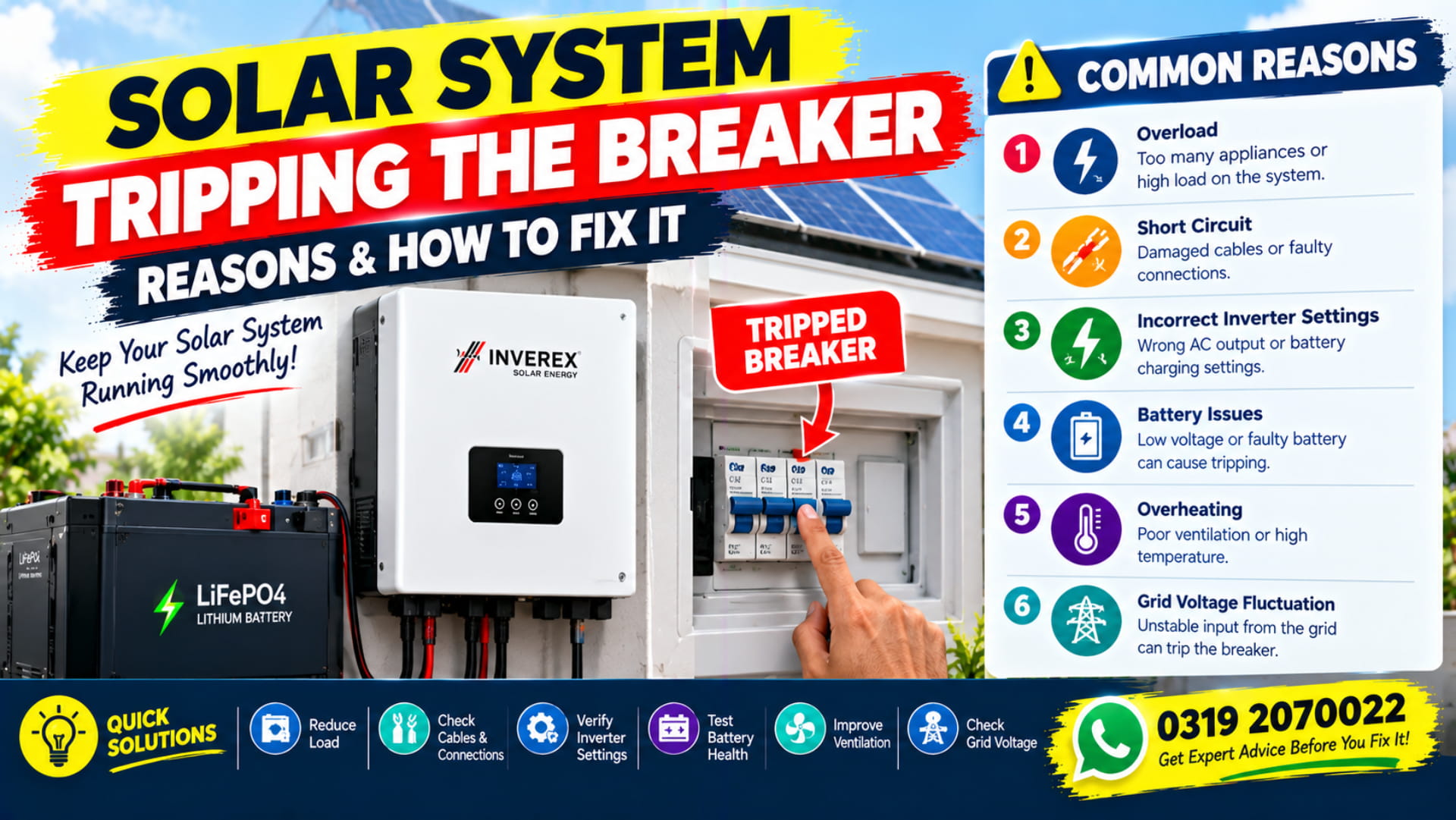
A breaker tripping is different from an inverter showing a fault message on its screen. A breaker is a separate mechanical safety device, and when it trips it cuts power completely and immediately, usually with an audible click, rather than displaying a code you can read and reason about. That makes it both more disruptive and, in some cases, a more urgent signal that something is genuinely wrong rather than the inverter protecting itself through software.
This guide covers where the breakers sit in a solar system, the difference between a trip worth investigating calmly and one that means stop immediately, the common causes in order, and a safe way to work through them.
Where the breakers actually are
A solar installation usually has more than one breaker, and knowing which one tripped narrows the problem considerably.
| Breaker location | What it protects |
|---|---|
| DC isolator near the panels | The PV wiring between panels and inverter |
| Battery breaker or fuse | The DC cabling between battery and inverter |
| AC output breaker | The wiring between inverter and your distribution board |
| Main distribution board breaker | The house wiring downstream of the inverter |
| RCD or ELCB (earth leakage device) | Protects people from a fault that is leaking current to earth |
If you are not sure which one tripped, check each breaker’s position. A tripped breaker usually sits in a visibly different position from a normal one, often midway rather than fully up or down, and most panels label each breaker by circuit.
A trip you investigate calmly versus a trip you stop for
Trips once, resets normally, and holds. This is worth understanding but is not an emergency. It often points to a load that briefly exceeded what the circuit could carry.
Trips again immediately on reset, especially fast and hard. Stop. Do not keep resetting it. This pattern, particularly with a smell of burning, scorch marks, or a breaker that feels warm, points toward a short circuit or a serious wiring fault that resetting will not fix and may make worse.
An RCD or ELCB trips specifically, rather than an ordinary breaker. This points to current leaking to earth, commonly through moisture, damaged insulation or a failing component, and it is a protection device working as intended, not a nuisance to silence.
Cause 1: Genuine overload on that circuit
The simplest explanation is that the connected load drew more current than the breaker is rated to carry. This is especially common on the AC output breaker or the main board breaker during load shedding, when every appliance in the house lands on the inverter at the same moment it switches over, which is a harsher test than normal daytime operation.
This is a different mechanism from the inverter’s own internal overload protection, which shows as a fault message on the display rather than a physical breaker click, and is covered in depth in our inverter overload problem solution guide. A breaker tripping on overload means the wiring and breaker are protecting themselves from more current than they can safely carry, regardless of what the inverter itself can technically supply.
Test it by switching off the heaviest appliances, particularly anything with a compressor or motor, and resetting the breaker with a lighter load. If it now holds, you have confirmed overload rather than a fault in the wiring itself.
Cause 2: A short circuit
A short circuit is a direct, low-resistance path between conductors that should not be connected, and it causes a very high, very fast current spike that a breaker is specifically designed to catch. A short can happen inside damaged cable insulation, at a connector that has come loose and is touching something it should not, inside a failed component, or from rodent damage to a cable, which is common where cabling runs through a roof space or conduit.
A short-circuit trip is usually instant, often louder or sharper than an overload trip, and frequently will not hold even with every load disconnected, because the fault exists in the wiring itself rather than in anything you are running. This is not a do-it-yourself repair. Isolate the circuit and have a technician trace the fault before re-energising it.
Cause 3: An earth or ground fault
If current is finding an unintended path to earth, through damaged insulation, a failed component, or water ingress, an RCD or ELCB will trip to protect anyone who might touch the affected equipment. This is one of the more common causes during Pakistan’s monsoon, when moisture works its way into junction boxes, connectors and the panel’s own cabling.
Ground faults can also develop gradually as cable insulation degrades under sun exposure over the years, so a system that has run fine for several seasons can still develop one. Humidity’s broader effect on component life, beyond this specific fault, is covered in our solar panel performance in Karachi humidity guide. An earth fault should always be traced and fixed rather than bypassed, since the device is there to prevent a genuine shock hazard.
Cause 4: The breaker is the wrong size for the installation
A breaker has to be matched to both the cable it protects and the equipment downstream of it. If an installer fitted a breaker rated too low for the inverter’s actual output, or too high for the cable gauge used, you get nuisance trips on one end or an unsafe, under-protected circuit on the other.
This is a design and installation issue rather than a fault that develops over time, so it is worth checking against the inverter’s rated output current and the cable’s rated ampacity, ideally by the installer who fitted it or a qualified electrician. Correct sizing at installation, along with correct earthing, is one of the details that separates a safe system from one that causes problems for years, which our solar panel installation in Karachi guide goes into.
Cause 5: Inrush current at startup
Compressors, pumps and the inverter’s own power-up sequence all draw a brief surge well above their running current, sometimes several times higher, for a fraction of a second. A breaker with a fast trip curve, often marked type B, can trip on this surge even though the sustained load afterward is perfectly normal.
If the breaker trips specifically at the moment an AC or pump switches on, and never while running steadily, ask an electrician whether a breaker with a slower trip curve, such as type C or D, suited to motor and inrush loads, is more appropriate for that circuit. This is a tuning issue rather than a safety fault, but it still needs a qualified person to change, since the wrong trip curve in the other direction reduces protection.
Cause 6: A loose or corroded connection
A connection with resistance generates heat under load, and in some cases this localized heating can trip a breaker through nuisance overcurrent or, in a worse case, develop into an arc fault. This is more common at battery terminals, DC combiner connections and anywhere two cables are joined rather than run as one continuous length, and it is accelerated by the corrosion that sets in faster in Karachi’s coastal air.
A connection like this often shows warning signs before it causes a trip: discolouration, a faint burning smell, or a terminal that feels warmer than its neighbours. Catching this during a routine check avoids it becoming the more serious short-circuit scenario above.
Cause 7: The breaker itself has worn out
Breakers are mechanical and electrical devices with a working life, and after years of switching and tripping, the mechanism can weaken and begin tripping below its rated threshold, or fail to reset cleanly. This is less common than the other causes but worth considering if a breaker has been in service for many years and trips under a load it comfortably handled before, with nothing else in the system having changed.
A worn breaker is a straightforward replacement, but it is worth confirming the cause genuinely is the breaker and not a developing fault elsewhere in the circuit before assuming age is the answer.
A diagnostic order that keeps you safe
Work through this in sequence, and stop at the first sign of danger.
- Note which breaker tripped and whether it is an ordinary MCB, an RCD or ELCB, or a DC isolator.
- Check for burning smell, scorch marks, or a hot breaker before touching anything further. If present, leave the system off and call a technician.
- Disconnect or switch off heavy loads, then reset the breaker once. If it holds, overload was the likely cause.
- If it trips again instantly with nothing connected, suspect a short circuit or earth fault in the wiring itself and stop resetting it.
- Inspect visible connections at the battery, inverter and distribution board for looseness, discolouration or corrosion, without opening any sealed enclosure.
- Note whether the trip coincides with a specific appliance starting, which points toward inrush current and a trip-curve mismatch.
- If none of the above explains it, or you are not confident working near live electrical equipment, call a qualified technician and describe exactly which breaker, what you have already ruled out, and whether it trips instantly or holds briefly first.
Never bypass a breaker, fit one rated higher than the original without an electrician’s confirmation, or repeatedly force a reset against a trip that will not hold. These responses remove the protection the breaker exists to provide.
Preventing repeat trips
Size circuits to the actual load, with a professional confirming breaker rating against both the cable and the connected equipment, rather than whatever was in stock on installation day.
Keep connections tight and clean, with an annual check that is more frequent in humid, coastal conditions, since loose and corroded joints are behind a meaningful share of nuisance trips.
Protect cabling from moisture and pests, sealing entry points and routing cables away from standing water, roof leaks and spaces rodents can reach.
Know your system’s genuine backup capacity and avoid routinely throwing every appliance onto it simultaneously during an outage, which stresses both the inverter and the breakers protecting it. The same discipline that prevents inverter overload, covered in our inverter not switching to battery guide, reduces breaker trips too.
Do not ignore a trip that keeps recurring. A breaker that trips once a year under an unusual load is normal wear on the system. One that trips weekly is telling you something needs fixing.
Getting help through BuySolars
Send us which breaker tripped, whether it holds after a reset, and whether anything unusual coincided with the trip, such as a specific appliance starting or recent rain. That is usually enough for us to point you toward the likely cause before a technician visits. We supply inverters, batteries and installation components with nationwide delivery, and current stock is on our products page.
WhatsApp 03192070022 with details of your breaker trip for a quick diagnosis.
Most often overload, a short circuit, an earth fault, or a breaker that was undersized at installation.
Only if it holds after resetting with a lighter load. A breaker that trips again instantly should not be reset repeatedly.
A breaker trip is a mechanical safety device cutting power entirely. An inverter overload fault is the inverter’s own software protection, shown on its display.
Moisture commonly causes earth leakage through damp junction boxes or degraded insulation, which an RCD is designed to detect.
No, not without a qualified electrician confirming the cable and equipment can safely carry the higher rating. A mismatched breaker removes protection rather than fixing the cause.